Business Opportunities for Swiss Companies in India in 2026
Swiss companies in India are gaining new business opportunities in 2026 through the India-EFTA Trade and Economic Partnership Agreement (TEPA). Lower tariffs, a USD 100 billion investment commitment, and access to India’s skilled workforce make India an attractive destination for expansion, hiring, manufacturing, and R&D.
India and Switzerland have been friends on paper since 1948, when they signed a Treaty of Friendship, which was independent India’s first. That history is nice, but it is not why a Swiss CFO is reading about India in 2026. The reason is a trade deal.
On 1 October 2025, the Trade and Economic Partnership Agreement between India and the EFTA bloc came into force. Switzerland is the largest economy in that bloc, so the deal lands hardest on Swiss firms. It changes how they sell into India, how they invest, and how easy it is to move talent both ways.
If India has been a maybe on your expansion list, the maths just moved. EFTA members have pledged 100 billion dollars into India over 15 years, with a target of one million direct jobs. India has reduced or is phasing out tariffs on the bulk of its imports. Below is what that means in practice, which sectors are gaining, and the cleanest way to hire in India without losing a year to entity setup.
What TEPA Changes for Swiss Companies
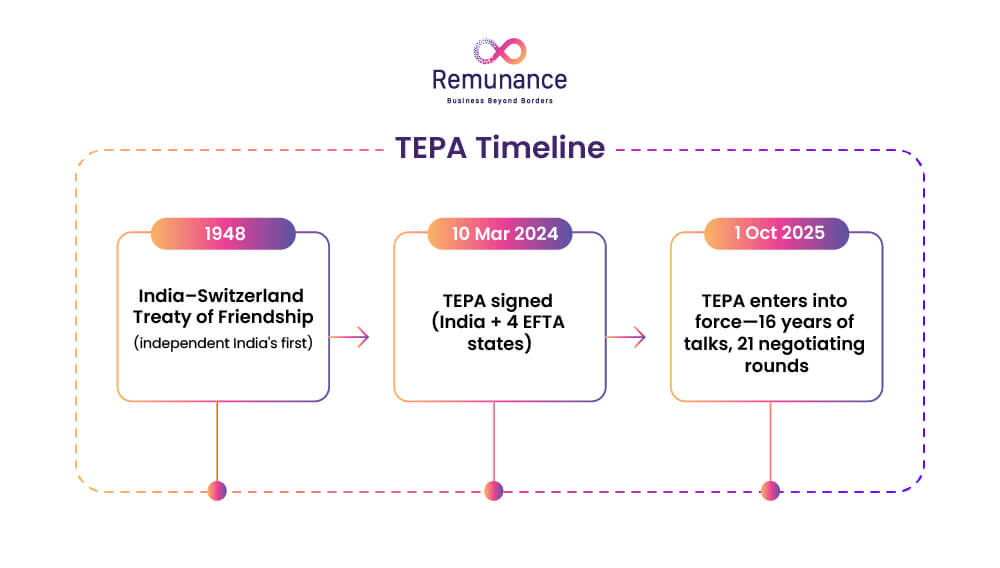
TEPA is the Trade and Economic Partnership Agreement. India signed it with the four EFTA states, Iceland, Liechtenstein, Norway, and Switzerland, on 10 March 2024. It came into force on 1 October 2025 once all countries had ratified it. The talks ran for sixteen years across twenty-one rounds, so this was not a rushed deal.
Two numbers do most of the work. EFTA has promised 100 billion dollars of investment into India over fifteen years, split as 50 billion in the first decade and another 50 billion in the five years after. That money is tied to creating roughly one million direct jobs inside India. No earlier Indian trade deal has linked investment to job targets quite like this.
On goods, India agreed to cut or remove duties on about 95.3 percent of its imports from EFTA, with gold as the main exception. For Swiss exporters, close to 84.6 percent of products will see all tariffs disappear once the phase-in periods end. The categories that gain the most are machinery, pharmaceuticals, precision instruments, medical devices, and watches, which are exactly where Swiss firms ship the most value into India.
Services were part of the deal, too. Swiss financial and insurance providers now face clearer, time-bound licensing rules in India, and the permitted share of foreign capital in insurance has been raised. For a company weighing an India entry, the regulatory path is more predictable than it was even two years ago.
Priority Sectors After TEPA
Five sectors carry most of the Swiss-India activity. TEPA gives them all a tailwind.
Pharmaceuticals
Swiss pharma has run R&D and manufacturing in India for years, drawn by the talent pool of scientists and lower trial and production costs. With duties easing under TEPA, the case for expanding Indian capacity gets stronger.
Machinery and Precision Instruments
This is where Switzerland sends serious value, and where the tariff cuts bite most. Industrial machinery, optical and medical devices, and instruments all become cheaper to land in India, which helps Swiss exporters compete against EU rivals who do not have this deal yet.
Financial Services
Swiss banks have a long history in India, though the lineup has changed. Credit Suisse, which once ran one of the larger foreign banking books in the country, was absorbed by UBS in 2023, so any reference to it as a standalone player is out of date. UBS, Julius Baer, and other Swiss institutions remain active. Under TEPA, licensing timelines for financial firms are now clearer, which removes one of the old frictions for new entrants.
Renewable Energy
Clean energy is a shared priority. Swiss firms have partnered with Indian utilities on areas like thermal energy storage, and the investment pledge under TEPA gives these projects more room to scale.
Information Technology
Swiss companies have outsourced IT and built captive centers in India for two decades. Many of the 330-plus Swiss firms in India run an R&D or technology function locally. The talent depth and cost gap keep this flowing.
Ready to Expand Your Swiss Business in India?
Whether you're expanding in pharma, manufacturing, finance, renewable energy, or IT, Remunance can help you hire talent in India quickly and compliantly—without setting up a local entity.
India-Switzerland Relations: A Historical Overview
India and Switzerland formed Diplomatic relations in 1948.
Over the years, the relationship between the two countries has deepened, moving beyond cultural exchanges to economic cooperation and trade partnerships.
Today, these two nations stand on the brink of a new era of collaboration, focusing on creating business opportunities, expanding, and pursuing mutually beneficial ventures.
Swiss Business in India, By the Numbers
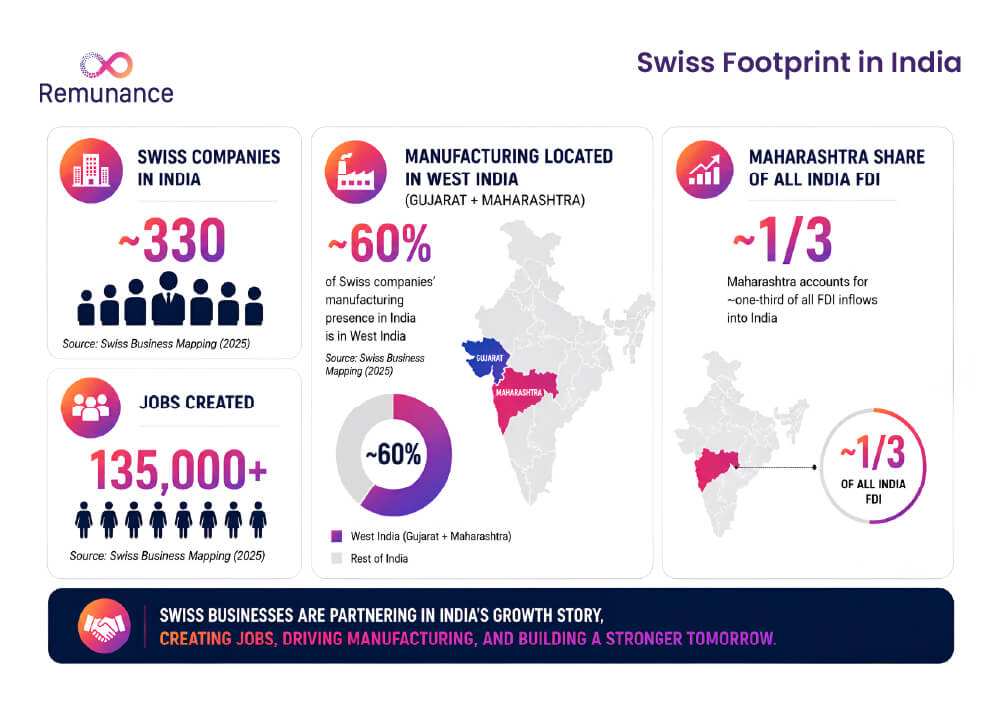
The Swiss footprint in India is bigger than most people assume. Around 330 Swiss companies operate in India today, and together they employ more than 135,000 people. That count comes from the Swiss business mapping published in 2025, up from the figures circulated a couple of years earlier.
Location matters. Roughly 60 percent of Swiss manufacturers sit in western India, across Gujarat and Maharashtra. Maharashtra alone draws close to a third of all foreign direct investment entering India, which is part of why Pune and Mumbai keep showing up in Swiss expansion plans.
Trade tells the same story. In 2024, Switzerland exported about 22.6 billion dollars of goods to India. A large slice of that, more than 20 billion, was gold and precious metals, with the rest spread across machinery, watches, optical and medical equipment, pharmaceuticals, and chemicals. India sent roughly 3 billion dollars the other way, led by organic chemicals, gems, electronics, and apparel.
| Metric | Figure | Source (year) |
| Swiss companies in India | ~330 | Swiss Business Mapping (2025) |
| Jobs created by Swiss firms | 135,000+ | Swiss Business Mapping (2025) |
| Swiss goods exports to India | USD 22.6 billion | UN COMTRADE (2024) |
| Swiss goods imports from India | USD 3.0 billion | UN COMTRADE (2024) |
| EFTA investment commitment | USD 100 billion / 15 yrs | TEPA (in force Oct 2025) |
| Target direct jobs from TEPA | ~1 million | TEPA |
| Swiss mfg located in West India | ~60% | Swiss Business Mapping (2025) |
| India cumulative FDI, all sources | USD 1.14 trillion | DPIIT (Apr 2000 to Dec 2025) |
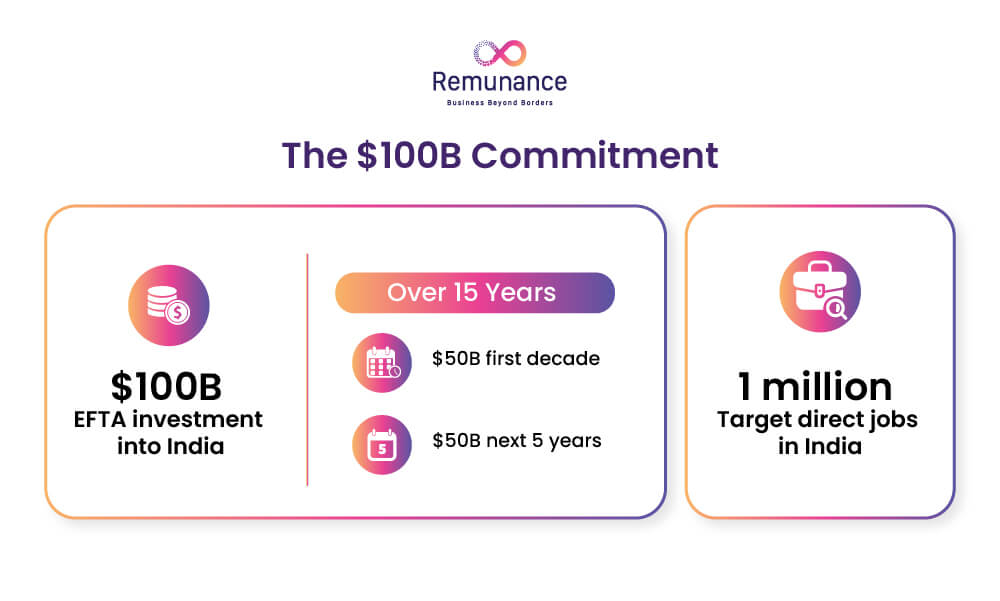
EFTA pledges $100B investment and 1 million jobs under TEPA
Business Expansion Opportunities for Swiss Companies in India
India’s Economic Landscape:
India’s economic landscape has witnessed remarkable growth, making it an attractive market for global businesses.
The country’s vast consumer base, technological advancements, and rapid growth of the middle class have positioned it as a key player in the global economy.
Attracting Global Businesses:
India has applied several smart strategies to attract global businesses.
Importantly, India reduced the corporate tax rate, addressed liquidity issues in non-banking financial companies, and banks enhanced the ease of doing business in India, and implemented reforms in the Foreign Direct Investment (FDI) policy.
India has attracted many foreign companies with its stable economic environment and skilled workforce, making it a favorable destination for Swiss businesses seeking to establish a robust presence in the Asian market.
Industries at the Forefront:
Industries at the forefront include information technology, pharmaceuticals, finance, and renewable energy.
The convergence of Swiss expertise and Indian resources creates a dynamic environment for innovation and growth.
Due to the implementation of favorable government policies, India has witnessed a drastic increase in its attractiveness as a destination for Foreign Direct Investment (FDI).
The Indian Government has supported these policies by emphasizing sectors like defense manufacturing, real estate, and research and development.
Remunance Employer of Record
Ready to Expand Your Business in India?
India offers Swiss companies access to a large market, skilled talent, and strong growth opportunities. Expand faster and stay compliant with expert support tailored to your India entry strategy.
Get Your India Expansion Plan
How Swiss Companies Can Hire in India Without an Entity
Here is the part most trade write-ups skip. A tariff deal opens the door, but you still need people on the ground to do business in India. That is where most Swiss firms hit their first real decision: set up an Indian subsidiary, or hire through an Employer of Record.
Setting up a private limited company gives you full control, but it is slow, and it is not cheap.
You need company registration, a resident director, several tax registrations, ongoing compliance filings, and usually a few months before you can legally pay anyone. For a company still testing the market, that is a heavy upfront commitment.
An Employer of Record is the faster route. The EOR is already a legal entity in India.
It hires the staff you pick, runs payroll, handles PF, ESI, professional tax, and TDS, and keeps you compliant with Indian labor law. You direct the work day to day. They carry the legal employer load. Most teams go live in a week or two rather than a quarter.
For a Swiss company that wants to ride the TEPA momentum without freezing capital in a subsidiary it may not need yet, the EOR route is usually the sensible first move. You can always incorporate later, once the India operation earns it.
Conclusion
The India-Switzerland story used to be about goodwill and a shared respect for quality. After 1 October 2025, it is about a working trade agreement with real money behind it.
For Swiss companies, India is no longer a someday market. The tariffs are coming down, the investment pledge is substantial and tied to jobs, and the local talent has already proven itself across pharma, engineering, finance, and technology.
The practical question is no longer whether to look at India, but how to enter without overcommitting. For most Swiss firms, the answer is to hire a small team through an EOR first, learn the market, and scale into a subsidiary when the numbers justify it.
Remunance Employer of Record
Ready to Enter India Without the Complexity?
Whether you're exploring India for the first time or planning a larger investment, the right entry strategy can save months of time and significant upfront costs. Discover how an EOR can help you expand faster and stay compliant from day one.
Get Your India Expansion Plan FAQs
Is the India-Switzerland TEPA in force?
Yes. TEPA came into force on 1 October 2025, after all four EFTA states and India finished ratification. It was signed on 10 March 2024.
How much are EFTA and Swiss companies investing in India under TEPA?
EFTA committed 100 billion dollars over fifteen years, 50 billion in the first ten years and 50 billion in the next five, tied to creating around one million direct jobs in India.
How many Swiss companies operate in India?
Around 330, employing more than 135,000 people, based on the 2025 Swiss business mapping. Most manufacturers are clustered in Gujarat and Maharashtra.
Which sectors benefit most from TEPA?
On the Swiss export side, machinery, pharmaceuticals, precision instruments, medical devices, and watches. Services such as financial and insurance providers also gain from clearer licensing rules.
What is the fastest way for a Swiss company to hire in India?
An Employer of Record. It lets you hire and pay staff in India within a week or two, without registering your own entity, while staying compliant with Indian labour and tax rules.
Should a Swiss company set up a subsidiary or use an EOR?
Use an EOR to test the market or run a small team. Move to a subsidiary when headcount, control needs, or long-term plans justify the cost and the heavier compliance load.

Related Posts

What is an Employer of Record (EOR)? A Complete Guide

Why India is a Strategic Choice for International Business Expansion?

Business Expansion Strategy: A Step-by-Step Guide to Success

A Complete Guide to Doing Business in India

What Are the Advantages and Disadvantages of Doing Business in India?