How Much Does an Employer of Record Cost? Full Breakdown
Discover the real Employer of Record cost in 2026, from monthly service fees to hidden compliance expenses. Learn pricing models, country-wise cost comparisons, and when an EOR is more cost-effective than setting up a local entity for global hiring and expansion.
Understanding the true Employer of Record (EOR) cost becomes absolutely vital for any organization planning to hire internationally. As global teams become more common, Global EORs provide a compliant, cost-efficient, low-risk solution.
But how much does an employer of record cost, and what are the benefits you get by onboarding a reliable EOR partner?
How Much Does an Employer of Record Cost?
The direct answer for this question is anywhere between $99 and $2,000 per employee per month, just for the service fee.
That number sits on top of the actual salary and the statutory taxes your hiring country forces every employer to remit. If a vendor quotes you $399 and stops there, they’re not lying. They’re just leaving out the bigger half of the bill.
Here’s the math that actually matters when you’re putting a budget in front of finance:
Total monthly cost per employee = Gross salary + Employer statutory contributions + EOR service fee + Add-ons
We see four pricing tiers in 2026, and each one buys you something different:
| Tier | EOR fee/employee/month | Who fits here & what you get |
| Budget | $99–$299 | Remunance, Remofirst, Skuad, Remote People. Self-serve platform, ticket-based support, lean overhead. |
| Mid-market | $400–$700 | Deel, Remote, Multiplier, Playroll. Larger feature set, dedicated CSM at higher volumes, mature integrations. |
| Premium | $800–$1,200 | Velocity Global, G-P, Atlas HXM. Enterprise compliance reviews, audited SOC 2 stack, named account team. |
| Custom/enterprise | $1,500+ | Bespoke contracts for 100+ headcount or sensitive regulatory contexts (finance, defense, healthcare). |
The reason the spread looks ridiculous is that you’re paying for very different things. At $199, you get a clean dashboard and a ticket queue.
At $1,500, you get a named account manager who replies to your Slack at 7 am Pacific. Both are real businesses. Neither one is right or wrong; it depends on whether your finance team needs predictability or your HR team needs hand-holding.
Hidden in that headline number is the question of what’s bundled and what gets billed separately. Some providers quote $399 and include benefits admin, equipment shipping, and offboarding. Others quote $299 flat, then itemise $250 per termination, $50 per off-cycle payroll run, and a 2% FX markup that quietly compounds. By the time you’ve signed, the cheaper option has cost you more.
This is the part most pricing pages skip. Below, we put the actual numbers on the table — line by line, country by country, so you can run your own math before you sign anything. For a quick estimate on India specifically, run your salary through our EOR cost calculator or compare it against the entity-vs-EOR cost calculator to see what your own subsidiary would cost over the same period.
Calculate Your Exact EOR Cost in India
Get a detailed breakdown of salary, statutory contributions, EOR fees, gratuity, and total employment costs in minutes.
Employer of Record Pricing Models

4 EOR pricing models to match your hiring strategy and budget.
1. Percentage of Payroll
Percentage to payroll is one of the most common and industry-wide accepted models, offering flexibility and being best suited for smaller organizations and companies with employees who have highly variable salary ranges or lower salaries.
The Range at which EOR companies charge is roughly 5% to 20% of gross monthly salary. However, the very risk of this mode is that it becomes exponentially more expensive for high-earning employees.
2. Flat Monthly Fee Per Employee
This is the best model for optimizing the cost of an Employer of Record for your business expansion. In this model, the EOR partner or your global EOR service provider would charge you a fixed monthly fee per employee that ranges from $99 for low-salaried individuals to as high as $2000 for the US workforce.
Organizations like Remunance, however, help you find the best Indian resources for your business, and as they are a local EOR (Indian EOR), they would never charge you more than $250 per employee per month.
Local EOR businesses like Remunance generally charge their client monthly EOR fees of $99-$249. You can click the calculator below to get a clear idea of the associated fees and details.
The key benefits of this model are that it helps organizations with predictable budgeting for the future and is ideal for businesses looking to pursue aggressive expansion or to set up an operations center through satellite offices in India.
The only limitation associated with this model is the lack of economies of scale at large headcounts.
3. Fixed Retainer Pricing
The third most commonly used model by EOR service providers is the fixed retainer pricing model, which is built for organizations that have a long-term vision, have hired resources, and do not wish to scale or increase headcount significantly in the near future.
A fixed retainer pricing model covers a pre-agreed number of employees over a set term and is mostly used by organizations that avoid variable costs and have a multi-country presence/ mission.
4. Custom Pricing Models
The fourth pricing model comes with a few notes and conditions of its own. It is best suited for organizations looking to offer unique benefits, have a hybrid entity, or are looking to go on a roll with high-volume hiring across the market.
As this model is built to cater to the exact requirements of the business looking to expand their workforce overseas, this model has no particular drawback; the only point pulling it down can be the costs associated with the customization.
Total Cost of Employment: Full Breakdown
The EOR fee is the smallest line item on your invoice. The other three buckets — gross salary, employer statutory contributions, and the long tail of add-ons — do most of the damage to your budget. Here’s every cost component, what it actually buys you, and what to ask your vendor about before signing.
| Line item | Typical range | What it covers |
| Gross salary | The agreed offer | Base pay before any deductions. Every downstream cost multiplies against this. |
| Statutory employer contributions | 8% – 45% of gross | Pension, social security, healthcare, unemployment — varies wildly by country. |
| EOR service fee | $99 – $2,000 / month | Platform, payroll processing, compliance, contracts, HR support. |
| Mandatory bonuses | 8.33% – 16.67% / year | 13th month in Brazil, Philippines, Mexico, and Portugal. Gratuity in India (4.81%). Aguinaldo in much of Latin America. |
| Pre-funded severance | 8% of gross monthly | Brazil FGTS, Italy TFR, Peru CTS. The EOR collects monthly and pays out on exit. |
| Setup/onboarding fee | $0 – $500 one-time | Background checks, contract drafting, and statutory registration. |
| Security deposit | 1 – 2 months of total cost | Refundable. Sits with the EOR as a buffer against payroll defaults. |
| FX markup | 1% – 3% of payroll | Hidden inside the conversion rate. Rarely shown as a line item. |
| Termination handling | $250 – $1,000 per exit | Final settlement, statutory severance calc, paperwork. |
| Off-cycle payroll run | $50 – $250 each | Bonus payouts, corrections, mid-month joiners. |
| Equipment procurement | 10% – 20% markup | Only if the EOR ships laptops and peripherals for you. |
| Visa & immigration | $1,500 – $5,000+ | One-time, only if you’re sponsoring work permits. |
A Worked Example: Senior Software Engineer in India through Remunance
Say the agreed gross is ₹20,00,000 per year (about $24,000 USD at current rates). Here’s what actually hits your books each month:
| Cost component | Monthly | % of gross |
| Gross salary | $2,000 | 100% |
| Employer Provident Fund (12% on a capped basic of ₹15,000) | $22 | 1.10% |
| Employer ESI (only if salary < ₹21,000/month — not applicable) | $0 | 0% |
| Gratuity accrual (4.81% of basic) | $48 | 2.40% |
| Group health insurance (mid-tier plan) | $80 | 4.00% |
| Remunance EOR service fee | $199 – $249 | 10 – 12% |
| Total monthly cost per employee | $2,349 – $2,399 | ~1.17 – 1.20× |
All in, you’re looking at roughly $2,350–$2,400 a month for a $2,000-a-month engineer. That’s a 1.17x to 1.20x multiplier on gross — one of the lowest in the world.
The same engineer earning $2,000/month in Germany would cost you closer to $2,900 once you factor in 19–22% employer social security plus a mid-market EOR fee.
France pushes past $3,200. Brazil sits above $3,400 because of FGTS, 13th-month, and INSS stacked together. The 1.17x India multiplier is the structural reason so many UK, US, Canadian, and Australian firms route their offshore engineering, finance, and back-office hires through Indian EOR partners. It isn’t because the EOR is cheap. It’s because India’s statutory load is low and the talent pool is deep.
If you want the full math on Indian PF, ESI, gratuity, and professional tax authority sources, the EPFO website publishes the statutory rates and contribution ceilings directly. Worth bookmarking when you’re negotiating with vendors who claim their India fees include contributions.
EOR Cost by Country: Regional Breakdown
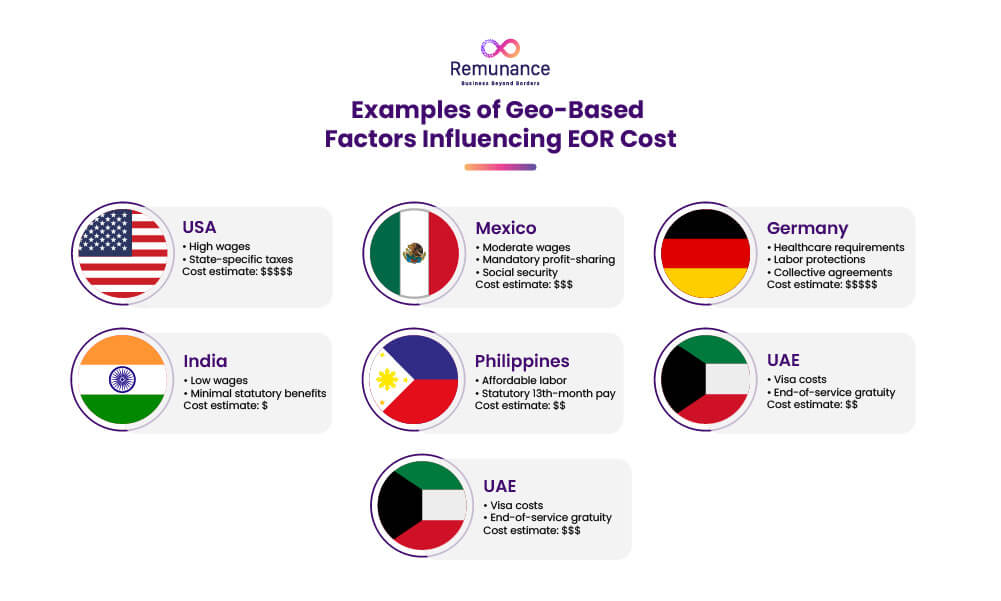
EOR costs vary by country — India is cheapest, Germany & USA the most expensive.
Country choice swings your fully loaded cost more than any other variable. A $60,000 base in Bengaluru and a $60,000 base in Paris will leave very different holes in your P&L — usually by a factor of two, sometimes more.
The table below splits the two things most pricing pages conflate: the EOR fee (what the vendor charges) and the statutory employer burden (what the government forces every employer to pay on top of gross, EOR or no EOR). Knowing the split matters when you’re comparing vendors, because some quote the burden inside their fee and some pass it through as a separate line.
| Country | Statutory employer burden | EOR fee (per employee/month) | What to know |
| India | 13% – 16% | $99 – $400 | PF 12%, gratuity 4.81%, ESI on low-wage roles. Cheapest major market. |
| Philippines | 9% – 11% | $299 – $500 | SSS, PhilHealth, Pag-IBIG. 13th-month mandatory. |
| Vietnam | 17% – 21% | $300 – $500 | Social, health, unemployment. Strong cost-quality balance. |
| United States | 7.65% – 10% | $500 – $1,500 | FICA, FUTA, SUTA. Healthcare adds $7K–$22K per employee per year. |
| United Kingdom | 14% – 15% | £500 – £1,200 | NIC at 15% above threshold. Pension auto-enrolment 3% minimum. |
| Germany | 19% – 22% | €700 – €1,500 | Health, pension, unemployment, long-term care. Roughly 50/50 employer-employee. |
| France | 40% – 45% | €900 – €1,800 | Highest employer load of any major economy. No negotiating around it. |
| Brazil | 35% – 70% | $600 – $1,200 | INSS, FGTS 8%, 13th-month, vacation bonus, profit-sharing. |
| Mexico | 28% – 32% | $500 – $900 | IMSS, INFONAVIT. Aguinaldo (Christmas bonus) is statutory. |
| Singapore | 17% | $400 – $1,200 | CPF for citizens and PRs only. Expats are dramatically cheaper. |
| Australia | 12% – 13% | AUD 600 – 1,400 | Superannuation 11.5% (rising to 12%). Otherwise light load. |
| Poland | 19% – 22% | $400 – $600 | ZUS contributions. EU compliance overhead adds to fee. |
| South Africa | 2% – 3% | $250 – $700 | UIF and SDL. Very light statutory load by global standards. |
Country quirks worth knowing before you sign
Brazil’s 70% headline isn’t all dead money. Roughly 8 percentage points is FGTS (Fundo de Garantia do Tempo de Serviço), deposited monthly into a worker’s account, which they can claim on termination.
Another big chunk is the 13th salary, paid in two installments through the year. The worker eventually receives it. You still pay it on day one. The Brazilian Federal Revenue Service publishes the full breakdown.
France’s 40–45% load is non-negotiable. It funds healthcare, unemployment, pension, training, transport, family benefits, and a long list of smaller levies. Early-stage startups can sometimes qualify for reduced rates under the Jeune Entreprise Innovante scheme, but assume the full load when you’re modeling costs.
India’s effective rate is even lower than the table suggests. Provident Fund is statutorily capped at ₹15,000/month of basic salary. Many employers, including most EORs, contribute to the statutory minimum rather than the full basic, which is legal and standard. For a $2,000/month engineer, your PF contribution is closer to $22 than to 12% of full salary. That’s the single biggest reason India routinely shows up as the cheapest major hiring market.
Germany has contribution ceilings. Pension and unemployment contributions stop at roughly €8,450/month of salary in 2026. Health insurance costs around €5,812/month. For senior hires earning above these caps, your effective employer rate drops — sometimes from 21% down to 15%. Useful to know if you’re hiring directors or principal engineers.
The US looks cheap on paper. Statutory FICA is only 7.65%. But health insurance, which is functionally mandatory for any competitive offer, adds another $7,000 to $22,000 per employee per year. Voluntary benefits push the real US multiplier to 1.30x–1.45x. Cheaper than Europe; nowhere near as cheap as India or the Philippines.
For Indian hires, our EOR cost calculator plugs your gross salary into the same formula above and gives you the all-in monthly. The entity-vs-EOR calculator does the parallel math if you’re choosing between staying on our EOR and setting up your own subsidiary.
Hidden Employer of Record Costs to Watch For
| Hidden Cost | Impact |
| Early Termination Fees | Charged if you end the contract before the agreed term |
| Currency Conversion | Margins added by providers for paying in local currencies |
| Mandatory Bonuses | Required in countries like Brazil or India |
| Backdated Compliance Penalties | If misclassification occurs |
| Onboarding or Exit Admin Charges | Charged per employee outside the monthly fee |
EOR vs Local Entity vs Contractor Costs
While an ideal breakdown of an EOR vs a Local entity would look like what is mentioned below, you can read about the other associated costs and which could potentially be avoided in our blog, EOR vs establishing an entity.
| Expense | EOR | Local Entity | Contractor |
| Setup Cost | $500–$2,000 | $10,000–$50,000+ | $0 |
| Monthly Admin | $99–$2,000 | $5,000–$20,000+ | $0 |
| Payroll Compliance | Included | $1,000–$5,000/year | Not included |
| Tax Filing | Included | $1,000–$3,000+ | Not applicable |
| Office Costs | Not applicable | $2,000–$10,000/month | Not applicable |
| Termination Costs | Included or minimal | Legal + Severance | Often none |
The best part of the above-mentioned blog, Eor vs Establishing an entity, is that it comes with a cost calculator, so you have the freedom to plug in your numbers and take our tool for a ride.
The EOR vs local entity tool also helps you understand the pricing difference of having an entity in India or hiring resources in India compared to European countries such as the United Kingdom and Germany.
Remunance Employer of Record
Compare EOR vs Entity Costs Before You Expand
See how much time, compliance effort, and operational cost you can save by using an EOR instead of opening a legal entity in India.
Compare Expansion Costs
When is EOR Worth the Cost?
EOR fees only feel high until you price the alternative. Setting up your own legal entity in India runs $20,000–$50,000 to register, another $10,000–$30,000 a year to maintain, and takes 8–16 weeks before you can cut your first paycheque.
In Germany, double those numbers. In Brazil, double them again, and add a requirement for a Brazilian-resident director, turning it into a hiring problem before it’s a registration problem.
By comparison, $199–$399 per employee per month is genuinely cheap. Until it isn’t.
Here’s the honest decision matrix we walk every prospective client through, before they sign anything:
Use an EOR when…
-
- You have fewer than 10–15 employees in a country and don’t expect headcount to exceed 25 in the next 18 months.
- You’re testing a new market and want the option to wind down cleanly if the bet doesn’t pay off.
- You need someone hired in three to five business days, not three months.
- You’re acquiring a small team via M&A and need them on payroll while you sort out the integration.
- Your hire is in a country with high termination friction (Brazil, France, Germany), and you want the EOR absorbing severance risk.
- You’re worried about permanent establishment risk and want the EOR to be the named local employer.
Don’t use an EOR when…
-
- You have 25+ employees in one country and have been rolling the contract over each year because nobody on finance has run the math.
- You plan to set up a legal entity within the next six months anyway. The transition cost rarely justifies a short EOR window.
- You’re hiring in your own country, in a state or province you’re already registered in.
- Equity is non-negotiable, and the country’s labor law makes EOR-issued options messy (France, Germany — workable, but check carefully).
- Your hire is going to be the local country head or GM. Those people almost always need to be directly employed by the parent.
Where the break-even sits, country by country
After working with hundreds of clients building offshore teams, we see consistent break-even patterns by jurisdiction:
| Country group | Break-even (entity becomes cheaper) | Why |
| UK, Ireland, Singapore | Around 10 employees | Low-friction entity setup; minimal ongoing compliance. |
| US, Australia, Poland | 12 – 15 employees | Moderate compliance; mature payroll infrastructure available. |
| Germany, France, Japan | 15 – 20 employees | Heavier termination law and benefits admin keep EOR sensible for longer. |
| Brazil, India, China | 25 – 35 employees | Compliance burden and termination costs make the EOR fee function like insurance. |
Those thresholds assume your team can read local employment law in the local language. If you can’t, add 30–50% to each break-even number to account for the legal and HR overhead you’d otherwise carry in-house — or pay external counsel to handle.
The speed-to-revenue math most companies miss
This is the argument that flips most CFO skeptics. Setting up an Indian subsidiary takes about 12 weeks if everything moves smoothly, including incorporation, PAN, TAN, GST registration, EPFO, ESIC, professional tax, bank account, and statutory licenses. During those 12 weeks, your engineering team in India isn’t shipping. Your sales rep in Mumbai isn’t selling. Your support lead in Hyderabad isn’t picking up tickets.
If that team had generated $200,000 in revenue or saved $150,000 in development costs over the gap, you’ve just spent a lot more than the EOR fee to “save” on entity setup. A good EOR closes the gap in 1–2 weeks. The fee is the speed premium, and the speed premium pays for itself within the first quarter for most use cases.
How to Reduce EOR Costs Without Compromising Compliance
While EOR cost is something that significantly leads the decision of choosing the right Employer of Record, it isn’t just about finding the cheapest option. It’s about cost-efficiency without legal or operational risk.
So, to find a perfect balance between cost efficiency and compliance, here is a short checklist of things you can do to reduce EOR costs without compromising compliance or legal parameters.
1. Hire in Cost-Effective Regions
The simplest way to manage compliance and cost is to prioritize developing countries as your preferred location. As a rule of thumb, developing nations are opportunity-hungry and very appreciative of capital invested in their workforce.
So the best countries to fit this bracket are India and the Philippines, with India standing out as the country with the largest English-speaking, work-ready population.
2. Limit Add-On Services
EOR services (especially the tool-based EOR) are bundled with numerous offerings. Make sure you select the tools/ add-ons you require, and remove all the optional benefits. Make sure you select only what is legally required, so you can effectively cut down on recurring costs.
3. Negotiate Volume-Based Discounts
The best way to secure discounts is to leverage economies of scale, so if you plan to scale or have a big team on hand, work to lock in the discounts based on the number of employees. Few EOR service providers even offer tiered discounts for the number of hires.
4. Localize Payroll Cycles
Payroll, when handled locally, ensures you can provide the best facilities for your workforce and remain highly compliant with local law. Being compliant with local law ensures you save millions of dollars in the future.
Remunance Employer of Record
Planning to Hire in India Without Setting Up an Entity?
Talk to Remunance’s EOR experts to understand your hiring costs, compliance obligations, and the fastest way to build your team in India.
Book a Free Consultation
FAQs
How much does an employer of record cost?
There’s no fixed number here. Some EOR companies charge a monthly fee per employee, while others take a percentage of payroll. In most cases, businesses end up paying somewhere between a few hundred to over a thousand dollars per employee every month, depending on where they’re hiring and what support they need.
Why do EOR prices vary so much from one provider to another?
A lot depends on the country you’re hiring in. Some regions have stricter labor laws, higher compliance requirements, or more paperwork involved. On top of that, things like payroll management, employee benefits, onboarding, and legal support can all push the cost up.
Is an EOR cheaper than opening a company in another country?
Usually, yes, especially if you only want to hire a small team. Setting up a legal entity overseas takes time, money, and a lot of admin work. An EOR lets companies skip that process and start hiring much faster without dealing with local registrations and compliance headaches right away.
Do EOR providers charge anything apart from the monthly fee?
Sometimes they do. A few providers charge extra for things like employee onboarding, contract setup, visa support, equipment shipping, or terminating an employee. That’s why it helps to ask for a full pricing breakdown before signing anything. The “starting price” doesn’t always tell the whole story.
Does it make sense for small businesses to use an EOR?
For many small companies, it actually does. If you’re hiring internationally for the first time, an EOR can save a lot of time and operational stress. Instead of building a legal and HR setup from scratch, businesses can focus on hiring people and growing the team first.

Related Posts

Employer of Record Switch: 7 Strategies for a Successful EOR Transition

How Does an Employer of Record Contract Work, and How to Create It?

Is Employer Of Record Legal?

A Guide to Employer of Record For Startups