



Summary
Payroll Compliance in India is critical for businesses to meet statutory obligations and avoid penalties. This article covers key payroll laws, including EPF, ESI, professional tax, TDS, and gratuity, and explains how compliant payroll processes ensure legal security, employee trust, and smooth business operations.
Expanding a business into a new nation always comes with both promising opportunities and challenges.
Especially when a country has a complex regulatory structure, such as India, the difficulty increases.
Payroll compliance in India is a significant aspect that foreign companies need to monitor closely.
India has a vast and complex system of labor laws that govern different areas of employment. It includes minimum pay, working hours, benefits, and termination procedures.
To ensure compliance, foreign businesses must become familiar with the key laws. Mainly, the PTA Act, the EPF Act, the ESI Act, and the Payment of Gratuity Act.
Before diving into the specifics of payroll compliance in India, let’s understand the importance of an employer of record.
But why???
Because it is one of the smoothest processes to avoid penalties and mitigate payroll compliance.
Under this contract, the EOR assumes the responsibilities of the hired employees’ legal employer.
EOR focuses on complying with Indian employment laws, taxes, and legal requirements. Under this arrangement, the company can focus on generating revenue.
So, let’s understand the importance of the 4 essential acts of Indian payroll compliance.
Understanding Payroll Compliance in India
Before examining EOR solutions, it’s essential to understand India’s rules and regulations.
Let us understand the different Indian compliances.
Compliance in India
To comply with Indian laws, one must have a comprehensive understanding of the complex framework and legal landscape.
In India, two types of compliance frameworks are in place. You must follow both company rules and government laws.
Compliance in India involves following the laws and regulations established by the government.
Statutory compliance, including labor and tax regulations, is also addressed. Compliance with rules, such as those set forth by the RBI and SEBI, is also included.
These are necessary for businesses to avoid legal issues, safeguard their reputation, and operate properly.
Hire in India—Stay 100% Compliant, 0% Hassle
Let Remunance handle complex Indian compliance so you can focus on growing your business.
Know How EOR Services Protect You from Compliance Risks in India4 Crucial Acts of Payroll Compliance in India
In India, payroll is subject to a number of laws and rules. All of those are important to protecting employees’ finances and ensuring their overall well-being.
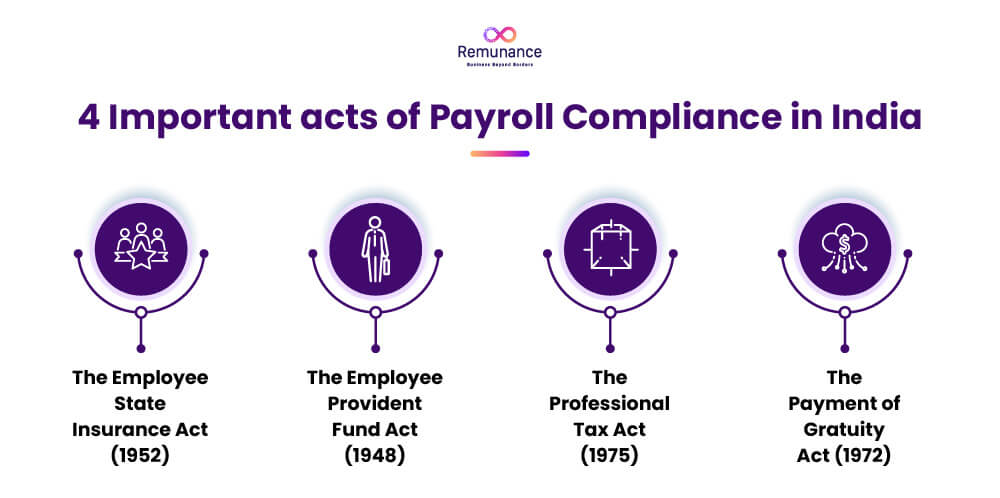
Here is a list of 4 important pieces of legislation that have a significant impact on Indian payroll management
-
- The Employee State Insurance Act (1952)
- The Employee Provident Fund Act (1948)
- The Professional Tax Act (1975)
- The Payment of Gratuity Act (1972)
It is essential to know the processes of contribution, the applicability of acts, and the subsequent benefits.
Employee Provident Fund Act 1952:
Applicability:
The EPF Act applies to companies with 20 or more employees. It covers both government and private companies, with some exceptions for certain workers. Most importantly, the employee’s salary must be more than 15000 per month.
Both the employee and employer must contribute 12% of the employee’s basic salary and dearness allowance.
From the employer’s 12% share:
-
- 8.33% goes to the Employee Pension Scheme (EPS)
- 3.67% goes to the Employee Provident Fund (EPF)
Benefits
Employees: The EPF Act gives workers the tools they need to build up a retirement fund, providing an assured financial future. It makes the entire corpus available if the candidate leaves or experiences a specific incident, such as unemployment or illness.
Employers: Employers can maintain their legal status by complying with the EPF Act. Additionally, it promotes worker well-being. This creates a team that is driven and loyal.
Retirement Funds
EPF aids employee retirement savings.
Monthly contributions are made to the fund by the company and the employee.
Tax Advantages
Section 80C allows for tax deductions for contributions to the EPF.
Typically, both the initial withdrawal and the interest generated are tax-free.
Financial Security
Government support for the Financial Security EPF is provided.
It provides constant, safe returns.
A portion of withdrawals
Before retiring, workers may take out a portion of their EPF.
This can be used for things like purchasing a home or meeting medical expenses.
Insurance Protection
EDLI is a life insurance program under EPF.
A lump-sum payment can be made to the employee’s family in the event of the employee’s death.
Pension Benefits
Once you retire, the EPS plan pays a monthly pension.
The EPF Act governs how it is run.
Employee State Insurance (ESI) Act, 1948:
Applicability: The ESI Act provides medical and financial benefits to insured employees and their families, and also includes businesses with ten or more employees.
Contribution: A certain percentage of the employee’s salary must be paid by both the employer and the employee. Employers contribute 4.75% of the gross income, while employees contribute 1.75%, according to my most recent information update.
Benefits
For Employees: If you pass away, the ESI Act provides financial assistance to your family. In the event of illness, maternity leave, or disability, it also provides financial support and medical care.
Employers: Your workforce remains healthy and strong when you comply with social security rules. Furthermore, it demonstrates your concern for your staff’s welfare.
-
- Medical Benefits: The ESI plan provides insured individuals (workers) and their families with comprehensive medical care, including treatment for illnesses, injuries, and maternity-related conditions.
Access to ESI clinics, hospitals, and dispensaries—which provide affordable and free medical care—is part of this.
Medical coverage covers both new and pre-existing conditions.
- Medical Benefits: The ESI plan provides insured individuals (workers) and their families with comprehensive medical care, including treatment for illnesses, injuries, and maternity-related conditions.
-
- Sickness Benefit: To make up for lost income during an absence, workers who are unable to work due to illness or accident receive cash benefits.
Over a continuous 365-day period, this compensation can be up to 70% of the worker’s average daily income for a maximum of 91 days, according to Navi.
- Sickness Benefit: To make up for lost income during an absence, workers who are unable to work due to illness or accident receive cash benefits.
-
- Maternity Benefit: Female workers are eligible for maternity benefits, including 100% of their pay during the leave period and up to 26 weeks of extended leave.
Professional Tax (PT) Act, 1975:
Applicability: Professional tax is a levy imposed by the state, and geographical differences may affect its rates and applicable characteristics. Generally, it refers to people and organizations engaged in trade, professions, or paid work.
Contribution: Employers pay the majority of professional tax at the employee’s source, with rates based on the worker’s income and the state-specific laws.
Benefits
For Employees: The money collected from professional taxes is used to fund state-specific programs, including healthcare, education, and infrastructure development.
For Employers: Adherence to state tax rules not only satisfies legal requirements but also demonstrates a dedication to regional development and regulatory compliance.
Payment of Gratuity Act, 1972:
Applicability: The Payment of Gratuity Act applies to companies with 10 or more employees. It provides workers with a monetary benefit when they leave the job, retire, or in the event of death or disability.
Only the employer must set aside this money. Employees don’t have to pay into it.
Advantages
For Workers: Each year of service, this act provides financial security in the form of a lump-sum payout, usually equal to 15 days of their most recent wage.
For employers: It is a powerful motivator for retaining personnel and emphasizes the dedication of employers to those who have faithfully served them.
Eligibility
Gratuities are given to employees who have worked for at least five years straight.
Payments
In the event of an employee’s retirement, resignation, death, or disability, they receive a gratuity payment.
Calculation
The basis for calculating gratuity is 15 days’ pay for each completed year of employment.
₹20 lakh is the upper limit.
Not contributing
Employee gratuities are not paid. The employer covers the entire cost.
Recognizing Long Service
Employees are rewarded with gratuities for their steadfast commitment and extended tenure.
In conclusion, the EPF, ESI, PT, and Gratuity Acts are necessary for payroll compliance in India.
Companies guarantee legal compliance and help with protecting employees’ funds.
To fully comply with the law, business executives must stay up to date on any changes to the law.
What is the solution to payroll compliance in India?
Payroll compliance management in India is a challenging yet crucial task.
Important laws, including professional tax, ESI, EPF, and gratuity, require careful consideration.
It’s essential to select the right EOR partner. It will help you comply with all employment and tax regulations. Primarily, focus on simplifying your growth in India.
When making your selection, consider the track record, expertise, and global presence of EOR firms such as Remuanance, Velocity Global, ADP, Shield GEO, and Globalization Partners.
With the right EOR partner, your company can confidently navigate Indian payroll compliance, unlocking the vast opportunities that the Indian market has to offer.
How will Remunance help navigate compliance for payroll?
Payroll management in India can be complex. Remunance simplifies it.
Remunance helps you hire people in India without the need to establish a local business. We handle all of your payroll compliance requirements as your Employer of Record (EOR).
We make sure your payroll complies with Indian tax and legal regulations. You don’t have to be concerned about deadlines or changing restrictions.
Remunance helps you stay in compliance and avoid penalties. We have already assisted more than 85 companies from 16 different countries in efficiently managing their Indian payroll.
More than 800 workers have been employed by us for our international clients in 34 Indian locations.
Remunance takes care of everything when you work with us, from government filings and employee perks to tax deductions and wage computations.
About Remunance
Remunance is an Employer of Record (EOR) services provider in India, helping global companies hire, manage, and support full-time employees without setting up a local entity. We take care of HR, payroll, compliance, and benefits so businesses can focus on growth while building their teams in India with confidence.
Remunance enables businesses from UK, Australia, Canada, France, US, and the Middle East to recruit, hire, and manage workforce and benefits in India.



FAQs
What is payroll compliance in India?
In India, payroll compliance means complying with all applicable laws regarding employee pay. This includes tax deductions, provident funds, employee state insurance, professional tax, and labor rules. To avoid trouble, businesses must abide by these regulations.
What is the payroll cycle in India?
India typically has a monthly payroll cycle. Salary payments are typically made at the end of each month. Depending on corporate policy, some might also adhere to a weekly or mid-month pattern.
How frequently do payroll laws change in India?
India’s payroll regulations may change annually. Usually, modifications to labor laws or the Union Budget bring about changes. Updates are necessary for businesses to remain compliant.
Recent

Also read
How Does the Payroll Calendar in India Work?
A Comprehensive Salary Calculator India and Payroll Optimization
https://remunance.com/blog/how-eor-manages-payroll-services-in-india/
https://remunance.com/blog/labor-laws-in-india/

