How to Implement a Successful Remote Work Strategy
Learn how to implement a successful remote work strategy with an 8-step framework covering remote work models, compliance, technology, onboarding, performance management, and global hiring. Discover how an Employer of Record (EOR) simplifies compliant remote hiring and team expansion in India.
What You Need to Know
Remote work stopped being an experiment somewhere around 2023. By 2026 it behaves more like infrastructure: a default that companies design around rather than react to.
The companies that struggle are rarely the ones that allowed remote work. They are the ones that allowed it without a strategy, then spent the next two years patching compliance gaps, chasing time zones, and wondering why their best hires kept leaving.
This guide walks you through how to build that strategy from the ground up. It covers the work models worth considering, the eight-step rollout, the legal traps that catch growing companies, and the specific playbook for hiring across borders into talent-rich markets like India.
Whether you manage three remote contractors or three hundred distributed employees, the structure below gives you a plan you can execute this quarter.
What is a Remote Work Strategy?
A remote work strategy is the documented set of decisions and systems that let your company employ people outside a central office while staying productive, compliant, and connected.
It answers four questions: who is eligible to work remotely, how you hire and pay them legally, which tools and security standards they operate under, and how you judge their performance.
A policy is not a strategy. A policy says “employees may work from home up to three days a week.” A strategy explains how that arrangement supports your hiring goals, how you onboard a developer in Pune as smoothly as one in Berlin, how you protect company data on a home network, and how a manager in London evaluates someone she has never met in person. The policy is one paragraph inside the strategy.
Get this distinction right and the rest of the work becomes execution. Skip it, and you end up with a flexible-sounding perk that creates legal exposure every time you hire across a border.
Why A Remote Work Strategy Matters More in 2026 Than It Did in 2021
Remote work is no longer growing explosively, but it has settled at a level that reshapes how companies compete for talent. In the United States, roughly 22 percent of the workforce now works remotely in some form, a baseline rather than a spike.
Among employees whose jobs can be done remotely, Gallup’s Hybrid Work Indicator finds that about 52 percent work hybrid, 27 percent fully remote, and only 21 percent fully on-site. The five-days-in-the-office default is gone for most knowledge roles.
The preference runs deeper than convenience. In Owl Labs’ 2025 survey, workers said they would trade close to 9 percent of salary to keep flexible hours. Stanford research led by economist Nicholas Bloom found that hybrid work had zero effect on productivity or promotions while sharply cutting attrition. And despite a wave of return-to-office headlines, Stanford and the Atlanta Fed report that only about 12 percent of executives plan a full RTO mandate, trimming the work-from-home share by less than half a percentage point. The mandates grab attention. The data barely moves.
Three forces make a deliberate strategy non-negotiable now:
Talent has gone global, and so has your competition for it
When location stops mattering, a startup in Amsterdam competes for the same senior engineer as a firm in Austin and one in Bangalore. Companies with real, trusted flexibility win candidates they could never afford to relocate. Bloom’s WFH Research consistently shows desired remote rates running ahead of what employers offer, which means the gap is a recruiting opportunity for whoever closes it first.
Compliance risk scales with every border you cross
Hiring one remote employee in another country can trigger payroll registration, tax withholding, mandatory benefits, and permanent establishment exposure that you never face hiring locally. A strategy that ignores this is a liability with a nice culture deck attached.
Outcomes-based management is now a skill, not a slogan
Managers who still equate presence with performance are losing their best people to managers who measure results. The strategy has to retrain how leaders lead.
Thinking about hiring remote talent across borders?
Before you build local entities, see how much faster and cheaper it is to hire compliantly through a partner who already has the infrastructure.
The 8-step Framework to Implement a Successful Remote Work Strategy
Use this as a sequence, not a menu. Each step depends on the one before it. You cannot design a fair performance system (Step 7) before you have decided which roles are remote (Step 3), and you should never onboard your first international hire (Step 5) before the compliance foundation is in place (Step 4).
Step 1: Define what the strategy is actually for
Start with the business goal, not the work model. Companies adopt remote work for very different reasons, and the reason dictates everything downstream.
If your goal is cost efficiency, you will weigh markets by total cost of employment and lean toward hiring where talent is strong and salaries are competitive.
If your goal is access to scarce skills, you will follow the talent wherever it lives and accept the compliance complexity that comes with it.
If your goal is retention, you will prioritize flexibility and async norms over headcount expansion. Write the goal down in one sentence and pin every later decision to it.
A practical test: if someone on your team proposes a new tool, hire, or policy, you should be able to say in one line how it serves the goal. If you cannot, it does not belong in the strategy yet.
Step 2: Choose your work model
Pick the model that fits the work, not the model that sounds modern. There are three viable options, and the right answer often varies across teams within the same company.
Fully remote suits output-driven roles where deep focus matters more than spontaneous collaboration: engineering, content, data, finance, operations, customer support.
Hybrid suits teams that need regular face time for mentoring, brainstorming, or client work, and it remains the most popular arrangement worldwide. Office-first still makes sense for roles tied to physical presence or tightly regulated environments.
You do not have to choose one model for the whole company. A common 2026 pattern is fully remote for individual-contributor knowledge roles, hybrid for managers and client-facing teams, and office-anchored “purpose days” where people gather for the work that genuinely benefits from being in a room together.
Step 3: Decide which roles are remote-eligible, and write the rules down
Treat remote eligibility as a role attribute, not a personal favor. The fastest way to poison a distributed culture is to grant flexibility on a case-by-case basis, because that turns a structural decision into office politics.
Build a simple matrix. For each role, score it on three things: how much of the work is independent versus collaborative, how sensitive the data it touches is, and whether it requires physical presence.
Roles that are independent, low on physical-presence needs, and manageable from a security standpoint are remote-eligible by default. Publish the logic so that every employee understands why their role sits where it does.
This is also where you document the boring essentials that prevent disputes later: core overlap hours, expected response times, equipment and stipend rules, and which country an employee may legally work from.
That last point matters more than most companies realize, because an employee who quietly relocates to another country can create tax and employment obligations you never signed up for.
Step 4: Get the legal and compliance foundation right
This is the step that sinks unprepared companies, so treat it as the load-bearing wall of the entire strategy. The moment you employ someone in a country where you have no legal entity, you inherit that country’s rules on payroll, income tax withholding, social contributions, mandatory benefits, termination, and data protection.
Get any of these wrong, and the cost is not a warning email. It is back taxes, penalties, misclassification claims, and, in the worst case, a permanent establishment ruling that exposes your global profits to local corporate tax.
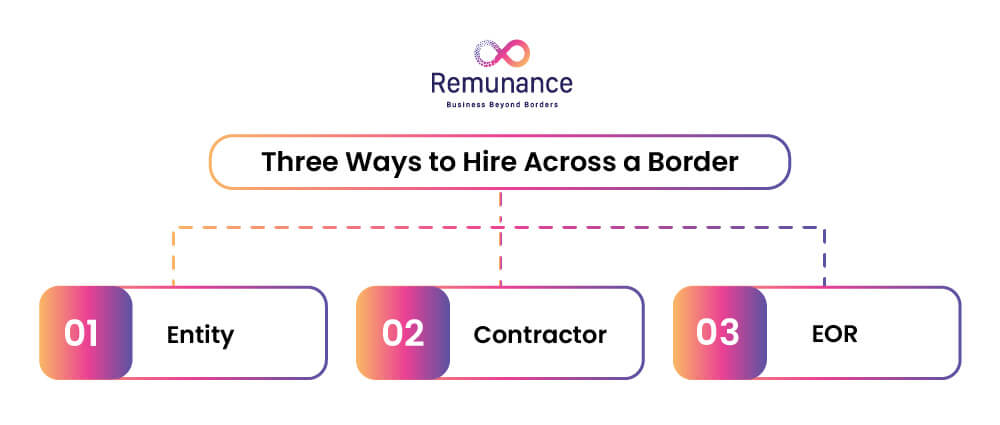
You have three ways to hire compliantly across a border:
-
- Set up a local entity. Full control, but slow and expensive. Incorporation, local directors, bank accounts, ongoing accounting, and statutory filings can take months. Worth it once you have dozens of employees in one country and a long-term commitment.
- Engage independent contractors. Fast and flexible, but legally fragile. If a contractor works full-time, follows your schedule, and uses your systems, many jurisdictions will reclassify them as an employee, and you absorb the back-dated liabilities. Remunance’s guidance on hiring independent contractors in India covers how to engage contractors without tripping permanent establishment and classification risk.
- Use an Employer of Record. An Employer of Record becomes the legal employer of your team in a country, handling contracts, payroll, tax, and statutory benefits, while you keep full control of the work. It is the fastest compliant route into a new market. If you are weighing the model, the benefits of an EOR and a breakdown of how to use an Employer of Record in India are good starting points.
The decision usually comes down to scale and timeline. One or two hires in a market, or a market you are still testing, points strongly toward an EOR.
A permanent, large-scale presence eventually justifies an entity, and many companies use an EOR first and transition to a subsidiary later once the headcount and certainty are there.
Step 5: Build a secure, low-friction tech stack
Your tech stack carries the entire weight of a distributed company, so design it for two outcomes: people can do their work without friction, and your data stays protected on networks you do not control.
Hybrid models that pair the right tools with proactive IT support report meaningfully higher collaboration and lower admin time, while teams in regions with weaker infrastructure see slower response times and more burnout. The tools are not a detail. They are the office.
Cover four layers. Communication needs a clear split between synchronous channels (video, instant messaging) and asynchronous ones (recorded updates, written briefs, documented decisions).
Collaboration needs a single source of truth for documents and projects so nobody works from a stale file. Security needs device management, a password manager, multi-factor authentication, and a VPN as the non-negotiable baseline, because cyber incidents increasingly originate from remote endpoints.
And HR and payroll need a system that can actually handle multiple currencies, local tax rules, and compliance tracking, rather than a spreadsheet stretched past its limits.
Resist the urge to buy fifteen tools. A lean stack that everyone uses beats a sprawling one that fragments attention and budget. Standardize, document the setup, and make onboarding to the stack part of day one.
Step 6: Hire and onboard for distance, not despite it
Remote hiring fails when companies bolt a webcam onto an office process. Redesign it. Write job descriptions that state the work model, the core hours, and the countries you can legally employ in.
Run structured interviews that test for written communication and self-direction, because those predict remote success far better than a confident handshake. And replace the in-person trial period with a clear 30-60-90 day plan that defines what good looks like at each milestone.
Onboarding is where distributed teams quietly win or lose. A new hire who spends their first week hunting for documents, waiting on equipment, and unsure who to ask will disengage before they ship anything.
Build a documented onboarding path: equipment shipped before day one, accounts provisioned in advance, a buddy assigned, and the first two weeks mapped out hour by hour.
When you hire through an EOR, the legal onboarding runs in parallel, which is why compliant first-day starts are realistic even across borders. Remunance, for example, onboards most employees within 24 to 72 hours of documentation.
Step 7: Manage by outcomes, not hours
The hardest shift in any remote strategy is psychological, and it lands squarely on managers: stop measuring presence and start measuring results.
Around 60 percent of managers say reduced visibility makes performance reviews harder, and that anxiety is what drives most clumsy return-to-office mandates. The fix is not surveillance. It is clarity.
Give every role outcome-based goals with defined success metrics, then review against those metrics on a predictable cadence. Replace “are they online?” with “did the work ship, on time, at quality?” Run short weekly one-on-ones focused on blockers and growth, not status updates that an async note could cover.
And make career progression legible: define how someone gets promoted in a remote role so that being out of sight never means being out of mind. Bloom’s research is blunt on this point.
Well-managed hybrid and remote teams match office productivity; the failures come from poor management, not from the location.
Step 8: Protect culture, wellbeing, and the people behind the output
A strategy that optimizes only for output eventually erodes the thing that produces it. Roughly a third of workers report burnout regardless of where they work, often because working from home blurs the line between work and personal time.
Remote employees can log higher engagement and higher distress at the same time. Autonomy and loneliness coexist.
Design against that. Set norms that protect boundaries: no expectation of instant replies outside core hours, meeting-free focus blocks, and visible permission to log off.
Treat remote staff as first-class citizens, so that perks, recognition, and information reach them as fully as they reach anyone in a head office.
Create deliberate connection through virtual rituals and, where budget allows, occasional in-person gatherings for the relationship-building that screens do poorly. And watch the leading indicators (engagement dips, quiet quitting, rising sick days) rather than waiting for resignation letters.
Build Your Remote Team with Confidence
Let an Employer of Record (EOR) handle hiring, payroll, compliance, and employee benefits, so you can expand globally without setting up a local entity.
Remote vs Hybrid vs In-office: How to Choose Your Model
The right model depends on the work, the talent market, and your goals, not on what your competitors announced on LinkedIn.
Use the comparison below to match each team to a model rather than forcing one model on everyone.
| Factor | Fully remote | Hybrid | In-office |
| Best for | Output-driven, independent roles | Teams needing regular collaboration | Presence-dependent or regulated roles |
| Talent reach | Global, unrestricted | Regional, within hub range | Local only |
| Productivity | High for focus; depends on management | Matches or beats office when run well | Strong collaboration, weaker deep focus |
| Real estate cost | Lowest | Reduced footprint | Highest |
| Culture risk | Highest if connection neglected | Balanced | Lowest |
| Compliance complexity | Highest across borders | Moderate | Lowest |
| Employee preference | Strong among knowledge workers | Most preferred model globally | Lowest for remote-capable roles |
Hybrid remains the most popular arrangement worldwide because it captures most of the upside of both ends, and the data shows it does so without sacrificing productivity or advancement.
But for companies hiring across borders to access talent or reduce cost, fully remote is often the whole point, and the model decision becomes inseparable from the compliance decision in the next section.
The Part Most Strategies Get Wrong: Compliant Global Hiring
Here is where a clean strategy meets messy reality. The moment your remote work strategy crosses a border, it becomes an employment law problem, and employment law does not care how good your culture deck is.
Consider what hiring a single full-time employee in India involves if you do it yourself. You need a registered presence to run compliant payroll.
You must withhold and remit Tax Deducted at Source (TDS), contribute to the Employees’ Provident Fund (EPF) and Employees’ State Insurance (ESI), manage gratuity and professional tax, and comply with the relevant Shops and Establishments Act.
Indian labor law is detailed, varies by state, and changes. One error in classification, payroll, or a contract can mean penalties or a misclassification claim.
An Employer of Record in India removes that entire burden. The EOR acts as the legal employer, so it owns the contracts, the payroll processing and statutory compliance, the tax filings, and the benefits, while you direct the work exactly as you would with any employee.
You get a compliant team in days, with no entity, no local HR department, and no exposure to the rules you have not had time to learn. For the full mechanics, see the guide to how an Employer of Record contract works.
The economics usually surprise first-time buyers. A local EOR in India typically charges a flat monthly service fee per employee on top of actual salary costs, far below the cost and lead time of incorporating and maintaining a subsidiary for a small team.
The complete cost breakdown of hiring remote employees in India lays out the numbers across hiring models so you can see exactly where an EOR wins and where an entity eventually catches up.
“Competing in the global economy takes very careful execution as any company builds a team in new economies. Having a trustworthy partner in-country eliminates enormous risk and raises the chances for success.”
— A sentiment echoed by Remunance clients expanding into India
Spotlight: Building a Remote Team in India
India deserves its own section because it is, for many global companies, the highest-leverage move in a remote work strategy: a deep, English-fluent, technically skilled talent pool at a fraction of Western salary costs.
Adoption of remote work is rising fast across Asia as digital infrastructure expands, and India sits at the center of that shift.
The path to a working India team follows six moves that map cleanly onto the framework above:
-
- Define the need. List the exact roles. Developers, marketing specialists, finance operations, and customer support are common first hires.
- Choose the hiring model. For a first team or a market test, an EOR is almost always the right call. The full reasoning lives in Remunance’s guide to building a remote team in India.
- Attract the right talent. Indian professionals weigh employer reputation, benefits, and growth heavily. A credible local employer of record strengthens your offer, and EOR-managed recruitment services can run sourcing through onboarding for you.
- Get compliant from day one. Contracts, TDS, EPF, ESI, and statutory benefits handled by the EOR.
- Set up communication and overlap hours. India works well with European and US East Coast schedules with modest overlap planning.
- Onboard into culture, not just systems. Introduce values, context, and the people, not only the tools.
A practical note on retention: India has also become a destination for returning professionals who want to keep their international roles while living closer to family.
Companies that can retain employees who relocate to India through an EOR keep institutional knowledge that would otherwise walk out the door. Build that option into your strategy, and you turn a common attrition trigger into a retention tool.
Remunance Employer of Record
Ready to build your India team?
Remunance has helped 120+ global companies hire across 34 Indian cities, with onboarding in as little as 24–72 hours and transparent, all-in pricing.
Hire in India, compliantly
How to Measure Whether Your Remote Work Strategy is Working
A strategy you cannot measure is a guess you cannot defend. Track a small set of metrics across four categories, review them on a monthly cadence, and let the trend lines, not anecdotes or the loudest manager, drive your decisions.
Productivity and output
Measure what ships, not who is online. Track on-time delivery rates, output per role against defined goals, and cycle time for key workflows. If output holds or improves while people work flexibly, the model is working, and the data gives you a calm answer to any return-to-office pressure.
People and retention
Watch voluntary attrition (especially among non-managers, who respond most strongly to flexibility), engagement scores from short pulse surveys, internal promotion rates for remote versus office staff, and time-to-hire. A widening gap between remote and office promotion rates is an early warning that your “out of sight, out of mind” problem is real.
Compliance and risk
Monitor the share of your workforce on compliant employment arrangements versus ambiguous contractor relationships, the number of jurisdictions where you employ people without a compliant setup, and your audit-readiness for payroll and tax in each market. The target is zero exposure, and an Employer of Record keeps this column green by design.
Cost and efficiency
Compare total cost of employment per role across markets, real estate spend before and after, and the all-in cost of your hiring route (entity versus EOR versus contractor). Many companies discover that a distributed team in a strong talent market delivers the same output at a materially lower total cost.
Set a baseline in your first month, then review monthly for the first quarter and quarterly after that. The goal is not a perfect dashboard. It is enough signal to catch problems while they are still cheap to fix.
Common Remote Work Strategy Mistakes to Avoid
Most failed strategies fail in the same handful of ways. Knowing them in advance is cheaper than learning them in arrears.
-
- Treating a policy as a strategy: A one-line work-from-home rule is not a plan for hiring, paying, securing, and managing a distributed workforce. Build the full system.
- Using contractors to dodge compliance: Engaging full-time workers as contractors to skip employment obligations is the fastest route to a misclassification claim and back-dated penalties. If the relationship looks like employment, treat it as employment.
- Ignoring permanent establishment risk: A senior employee with authority operating from another country can create a taxable presence for your company there. This is invisible until it is expensive.
- Buying tools instead of building habits: Software does not create culture or accountability. Norms and management do.
- Measuring hours instead of outcomes: Presence theater rewards the people best at looking busy and punishes the ones quietly delivering.
- Forgetting that remote staff are easy to overlook: When recognition, information, and promotions flow to whoever is physically visible, your remote team becomes a flight risk.
- Letting people relocate without telling you: A quiet move to another country can shift your entire compliance posture. Make location a documented, approved decision.
Your Remote Work Strategy Implementation checklist
Use this as a launch checklist. If you can tick every box, you have a strategy rather than a hope.
- ☐Business goal for remote work written in one sentence
- ☐Work model chosen per team (remote, hybrid, or office)
- ☐Role-eligibility matrix published with clear logic
- ☐Approved work locations and relocation rules documented
- ☐Compliant hiring route chosen per market (entity, contractor, or EOR)
- ☐Payroll, tax, and statutory benefits handled for every jurisdiction
- ☐Tech stack standardized across communication, collaboration, security, and HR
- ☐Security baseline enforced: MFA, device management, password manager, and VPN
- ☐Structured remote hiring and 30-60-90 onboarding process in place
- ☐Outcome-based goals and review cadence defined for every role
- ☐Manager training on remote leadership completed
- ☐Wellbeing and connection norms set and modeled by leadership
- ☐Leading indicators tracked monthly (engagement, burnout signals, and attrition)
Bringing It Together
A successful remote work strategy is not a flexibility perk dressed up in a slide deck. It is a system: a clear goal, the right work model, eligibility rules everyone understands, a compliance foundation that holds up across borders, a tech stack people actually use, hiring and onboarding built for distance, outcome-based management, and a real investment in the people doing the work.
The companies that win the next phase of distributed work are not the ones with the most generous policy.
They are the ones with the most deliberate strategy, executed by managers who lead by results and supported by infrastructure that keeps every hire compliant from day one.
Get the foundation right and remote work stops being a risk to manage. It becomes the advantage that lets you hire the best person for the job, wherever that person happens to live.
If that person is in India, that is where Remunance comes in. As India’s specialist Employer of Record, we handle the hiring, payroll, compliance, and benefits so you can focus on the work and the people, not the paperwork.
Remunance Employer of Record
Build your remote team without building an entity.
Remunance handles recruitment, payroll, and 100% compliance so you can hire top talent in India in days. Transparent pricing, no hidden costs.
Schedule a free consultation FAQs
What is the first step in implementing a remote work strategy?
Define the business goal in one sentence before anything else. Companies adopt remote work for cost efficiency, access to scarce talent, or retention, and the reason determines your work model, hiring markets, and management approach. Strategy follows goal, not the other way around.
Is remote work still growing in 2026?
Remote work has stabilized rather than grown explosively. In the US it sits around 22 percent of the workforce, and among remote-capable employees roughly 52 percent are hybrid and 27 percent fully remote. Return-to-office headlines are loud, but Stanford and Atlanta Fed data show only about 12 percent of executives plan a full RTO mandate.
How do I hire a remote employee in another country legally?
You have three options: set up a local entity (slow, costly, best at scale), engage independent contractors (fast but legally risky if they work like employees), or use an Employer of Record that becomes the legal employer and handles payroll, tax, and compliance for you. For one or a few hires, an EOR is usually the fastest compliant route.
What is the difference between a remote work policy and a remote work strategy?
A policy is a single rule, such as how many days employees may work from home. A strategy is the complete system around remote work: eligibility, compliant hiring, tooling, security, performance management, and culture. The policy is one component inside the strategy.
How much does it cost to hire a remote employee in India?
Through a local Employer of Record, you typically pay actual salary plus a flat monthly service fee per employee, which is far cheaper and faster than incorporating a subsidiary for a small team. The full cost guide for hiring remote employees in India breaks down the numbers across hiring models.
How do you manage remote employees fairly?
Manage by outcomes, not hours. Set clear, measurable goals for every role, review against them on a predictable cadence, run short one-on-ones focused on blockers and growth, and make promotion criteria explicit so remote staff are never overlooked. Surveillance backfires; clarity works.
What is the biggest risk in a remote work strategy?
Compliance, specifically employee misclassification and permanent establishment exposure when hiring across borders. These risks are invisible until they generate back taxes, penalties, or claims. Anchoring cross-border hiring on an EOR removes most of this risk.

Related Posts

Working Remotely in India Without an Employer of Record – Risks and Solutions

What Are the Benefits of Remote Working?

What Are the Current and Future Remote Work Trends?

Remote Workforce Solutions: Outsourcing, EOR, and Independent Contractors

Top Remote Working Challenges and How to Overcome Them