


A Comprehensive Salary Calculator India and Payroll Optimization
The Salary Calculator India helps businesses accurately estimate total employee costs in India, including taxes and benefits. This guide explores payroll models, the distinction between net and gross pay, and optimization strategies for better financial planning.
📑 Table of Contents
Understanding your salary structure is essential for both employees and employers.
We provide an in-depth analysis that simplifies the complexities of Indian payroll systems and demonstrates how leveraging an advanced salary calculator India can optimize your net earnings.
Understanding the Salary Structure India
Navigating the complexities of the Indian pay structure requires a strong understanding of its various elements.
We dissect the components to help you understand how your entire salary is calculated and how strategic planning can maximize your take-home pay.
Indian pay scales go beyond a set figure shown on your pay stub.
Together, they constitute the Cost to Company (CTC) from fixed components, variable incentives, and statutory deductions.
By breaking these components out, we enable you to budget, negotiate effectively, and assess proposals.
Key Components of an Indian Salary Structure
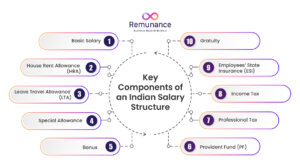 Every
Every
component of your pay scale is essential to your total remuneration.
We list the main elements below, together with their importance:
Basic Salary
Usually representing 40–50% of the CTC, your pay is based on your basic salary.
It is the basis upon which further deductions and benefits are computed.
Determining contributions toward Provident Fund (PF), gratuity, and other statutory benefits depends critically on this completely taxed component.
House Rent Allowance (HRA)
HRA is meant to cover housing costs. Section 10(13A) exempts it either partially or totally from taxes if you live in rented housing.
HRA becomes totally taxable for those not renting. You can control your tax load by maximizing HRA claims.
Leave Travel Allowance (LTA)
LTA is given to cover travel costs on leave. Under Section 10(5), workers may seek tax exemptions with the correct paperwork.
This allowance helps with travel arrangements and acts as a strategic tool in pay negotiations as well.
Special Allowance
Special allowances give leeway inside the pay scale. Usually, they are changed depending on business policy and personal talks; they are totally taxable.
Special allowances, as a variable component, can be customized to meet both personal and corporate budgetary objectives.
Bonus
Performance-based incentives included in the gross pay are bonuses.
Usually distributed at the end of the financial year, these fully taxable payments add to the whole appeal of the pay scale and act as a reward for extraordinary performance.
Provident Fund (PF)
Under the Employees’ Provident Fund (EPF) arrangement, an employee and their company pay 12% of the base pay each.
The employee pension scheme (EPS) and the EPF split the employer’s share.
Not only are long-term savings dependent on PF contributions, but they also affect the computation of taxable income.
Professional Tax
Region and income level affect this deduction, particularly in each state.
Though the figure may seem small, it is a necessary part of the overall pay system and ensures compliance with local tax laws.
Income Tax
The income tax is calculated on your taxable income, following all relevant deductions and exemptions.
Simplified tax systems have made income tax computation clearer, but your net pay is still much influenced by this factor.
Employees’ State Insurance (ESI)
Relevant to employees below a given level in companies with a particular staff count, ESI offers basic social security and health benefits.
Employers and workers each pay a small portion of their gross pay, thereby preserving welfare benefits.
Gratuity
A gratuity is a one-time gift given in thanks for long-term service. It is due under the Payment of Gratuity Act upon retirement, resignation, disability, or death.
Though not a regular feature, it is a major component of long-term employee perks.
Need Help Understanding Your Salary?
Our experts are here to guide you through every component of your Indian salary structure and answer any questions you may have.
Defining Critical Payroll Terminology
A clear grasp of key terms is necessary to decode your salary structure:
-
- Cost to Company (CTC): shows an employer’s whole outlay, including gratuity, basic pay, allowances, employer PF payments, and other benefits.
- Gross Salary: Including the basic pay as well as all allowances and incentives, the entire income before deductions.
- Net Salary: The gross pay is less the amount left after all statutory deductions—including income tax, professional tax, and PF.
- Take-Home Salary: Following obligatory and optional deductions, the actual amount credited to an employee’s bank account.
Navigating Tax Regimes: Old Versus New
India’s tax scene presents two separate regimes, each of which affects your take-home pay differently.
Here we offer a thorough comparison to help you make an informed decision.
Old Tax Regime
The Old Tax Regime enabled a broad range of exemptions and deductions.
It lets taxpayers benefit in several areas, including 80C, 80D, and HRA exemptions.
For those who invest in tax-saving devices, this government is quite advantageous, even if it requires thorough documentation and substantiation.
Key Advantages:
-
- Extensive deductions including EPF, PPF, ELSS, and more.
- Tax exemptions on allowances like HRA and LTA.
- Greater scope for reducing taxable income through strategic investments.
New Tax Regime
With reduced rates and the elimination of most exemptions and deductions, the New Tax Regime streamlines tax computation.
This system is designed for those who would like simple filing without the need for thorough paperwork, since salaried people already have a standard deduction.
Key Advantages:
-
- Streamlined tax slabs with lower rates.
- Simplified compliance and easier tax filing.
- Enhanced benefits for individuals with minimal investments in tax-saving instruments.
Updated New Tax Regime Tax Slabs
| Taxable Income Range (₹) | Income Tax Rate (%) |
| 0 – 12,75,000 | 0 |
| 12,75,001 – 15,00,000 | 5 |
| 15,00,001 – 20,00,000 | 10 |
| 20,00,001 – 25,00,000 | 15 |
| 25,00,001 – 30,00,000 | 20 |
| 30,00,001 – 40,00,000 | 25 |
| 40,00,001 and above | 30 |
This update essentially pays zero tax for taxpayers with taxable incomes up to ₹12.75 lakh, hence significantly improving net take-home pay for a wider income range.
Key Implications
-
- Zero-Tax Threshold Extension:
Now that the threshold is ₹12.75 lakh, a much larger number of taxpayers benefit from complete tax liability rebates. For middle-class people, this shift should increase disposable income.
- Enhanced Standard Deduction:
The rise to ₹75,000 reduces taxable income, therefore directly improving take-home pay for salaried workers. - Strategic Financial Planning:
These changes enable companies and workers to arrange pay components better and maximize tax planning, therefore ensuring that compensation packages stay competitive in the present economic environment.
- Zero-Tax Threshold Extension:
Step-by-Step Salary Calculation Process
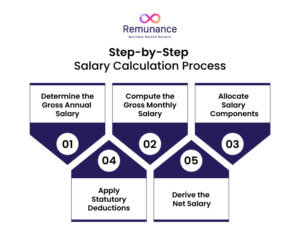
A robust pay calculator breaks the CTC into reasonable chunks and applies relevant deductions.
The process is methodically broken down here:
-
- Determine the Gross Annual Salary:
Start by noting the overall CTC. This covers all components, fixed and variable.
- Compute the Gross Monthly Salary:
To figure the monthly income before deductions, divide the annual CTC by twelve.
- Allocate Salary Components:
The gross pay is broken out into special incentives, allowances (HRA, LTA, etc.), and the basic income. Every element has a weight determined by corporate policy.
- Apply Statutory Deductions:
Deduct sums for income tax, professional tax, and EPF. One can also consider other deductions, including ESI and voluntary donations.
- Derive the Net Salary:
To get your take-home pay, subtract the total deductions from your gross monthly income.
- Determine the Gross Annual Salary:
Advanced pay calculators allow businesses to automate this process, thereby ensuring accuracy, reducing human errors, and ensuring compliance with regulations.
Remunance Employer of Record
Need Help Understanding Your Salary?
If the salary calculation process feels complex, our experts are here to guide you with clarity and accuracy.
Talk to our Expert
Salary Calculator India: Streamlining Payroll Management
Through simplifying difficult computations, automated salary calculators have transformed payroll processes.
We use these instruments to provide unparalleled accuracy and effectiveness.
Benefits of Using a Salary Calculator
-
- Accuracy: Automated calculations guarantee accuracy in pay breakdowns and remove human mistakes.
- Time Efficiency: Quick computation saves a lot of time and lets HR experts concentrate on strategic issues.
- Financial Transparency: Comprehensive breakdowns encourage openness and trust by helping workers grasp their pay and deductions.
- Regulatory Compliance: Following the most recent statutory rules and tax legislation fits very nicely into the computation procedure.
- Customization: Salary calculators can be customized to fit different pay systems, tax codes, and special corporate regulations.
- Accuracy: Automated calculations guarantee accuracy in pay breakdowns and remove human mistakes.
These benefits enable companies and staff members to build competitive pay schemes and make wise financial decisions.
Maximizing Your Take-Home Salary
Strategic planning and salary component optimization help you to increase your net earnings. Here are some practical suggestions:
Optimize Your Salary Structure
-
- Leverage Tax-Free Allowances:
Maximizing elements like HRA and LTA will help to greatly lower taxable income. For instance, making sure HRA lines up with actual rental costs will reduce your tax load.
- Utilize Section 80C Benefits:
Deductions from EPF, PPF, ELSS, and similar instruments go up to ₹1.5 lakh. We counsel matching your investments with these clauses to maximize savings.
- Adjust EPF Contributions:
Contributing the minimum required can improve take-home pay for staff members making above a particular level. Still, choosing Voluntary Provident Fund (VPF) will increase retirement savings and provide extra tax advantages.
- Leverage Tax-Free Allowances:
Choose the Right Tax Regime
-
- Evaluate Investment Patterns: The Old Tax Regime might be better if your financial plan calls for large investments in tax-saving devices.
On the other hand, the New Tax Regime can be perfect if you want a more straightforward approach with less assertions.
- Perform Scenario Analysis: Run both tax situations using sophisticated calculators. Depending on your income structure and investment portfolio, this study might show the best approach.
- Evaluate Investment Patterns: The Old Tax Regime might be better if your financial plan calls for large investments in tax-saving devices.
Strategic Salary Negotiation
- Emphasize Net Earnings: Focus on take-home pay rather than gross CTC during wage talks. Openness about deductions helps both sides reach a mutually beneficial compromise.
- Negotiate Variable Components: Talk about performance-based incentives and flexible benefits to guarantee your pay plan is both tax-efficient and competitive.
Advanced Payroll Optimization for Global Businesses
Good payroll control is absolutely vital for international companies doing business in India.
With our Employer of Record Services, we provide customized solutions guaranteeing compliance, simplification of procedures, and an increase in operational effectiveness.
Key Advantages for Global Employers
-
- Automated Payroll Systems:
Integrated systems streamline statutory compliance, tax deductions, and payroll computations, thereby reducing administrative burden.
- Customizable Salary Structures:
Flexible systems let one design salary structures that fit local rules as well as international norms.
- Enhanced Employee Engagement:
Clear insights on earnings from transparent payroll systems with self-service portals help to raise employee happiness and retention.
- Risk Mitigation:
Automated systems reduce the risk of errors and ensure compliance with Indian labor laws, thereby preventing potential legal problems.
- Automated Payroll Systems:
Remunance Employer of Record
EOR - Your Global Payroll Game-Changer!
Simplify complex salary structures and maximize earnings experience effortless payroll management worldwide.
Book a call now! Case Study – Effective Salary Breakdown Calculation
Imagine a situation where a company presents a CTC of ₹13,00,000 yearly. Our approach calls for:
-
- Calculating Gross Monthly Salary:
Dividing the annual CTC by twelve yields a gross monthly pay of over ₹1,08,333.
- Allocating Salary Components:
Along with allowances like HRA and LTA, the base pay, which represents about 40–50% of the CTC is fixed. Special allowances are changed in line with the pay policy of the company.
- Deductions Application:
Statutory deductions include:
- Employee Provident Fund (EPF): Based on a 12% contribution, about ₹1,800.
- Professional Tax: Different depending on state, say ₹200.
- Income Tax: computed under the New Tax Regime using the current tax slab—that is, ₹7,083.
- Final Take-Home Calculation:
By subtracting the whole deductions from the gross monthly pay, one gets a net monthly pay of over ₹97,450.
- Calculating Gross Monthly Salary:
This case study shows how accurate calculations and thorough breakdowns could streamline financial planning and payroll handling.
Integrating Salary Calculators with Business Operations
Modern payroll systems guarantee real-time data accuracy by including salary calculators in more general HR and financial systems, therefore simplifying processes.
We have found that the flawless combination of these instruments provides the following advantages:
- Real-Time Updates: Salary computation reflects automatically changes in tax rules or employee data.
- Data-Driven Decision Making: Comprehensive reports and analyses let management control payroll expenses, create budgets, and maximize payback on compensation plans.
- Employee Self-Service: Accessible dashboards and portals enable staff members to have knowledge about their pay components, deductions, and benefits, therefore encouraging responsibility and trust.
- Scalability:Automated systems guarantee that payroll processing stays error-free and efficient across several countries as companies expand.
Conclusion
We have compiled a thorough guide exploring the subtleties of Indian pay systems and the transforming power of salary calculators in contemporary payroll control.
Our study seeks to enable companies and staff members to make wise financial decisions by breaking out each pay component, contrasting tax laws, and including useful case studies.
Using these techniques not only increases take-home salary but also supports payroll operations’ efficiency and openness.
Automated tools and sophisticated systems enable companies to focus on expansion while maintaining compliance with evolving legislative rules.
We advise companies and professionals who wish to improve their payroll systems to use the knowledge in this book to achieve operational excellence and financial optimization.
Our all-encompassing strategy is meant to satisfy the needs of the fast-changing modern market and open the path for sustainable financial planning.
Using creative salary calculators and simplified payroll systems guarantees that every component of your pay is maximized, compliant, and customized to your particular financial situation.
Our thorough investigation of tax laws, pay scales, and strategic planning is intended as the last tool to help one fully understand payroll in India.
This book provides evidence of the ability of accuracy and automation to provide financial clarity and improved net earnings as you negotiate the complexity of tax planning and salary computation.
Adopting these best practices will help you change your payroll system and produce outstanding financial results.
Whether you are an employer creating competitive compensation plans or an employee negotiating your next pay scale, our thorough study is specifically meant to assist your objectives.
We are still dedicated to providing sophisticated payroll solutions and professional advice to improve your financial handling methods.
Discover the clarity, accuracy, and empowerment that follow from controlling your Indian salary structure.
Crack the Global Payroll Code!
Transform salary calculations into a breeze and elevate your take-home pay.

FAQS
What does the Cost to Company (CTC) include?
The total of all costs paid by an employer including the base pay, allowances, employer contributions to PF, gratuity, bonuses, and other benefits defines CTC.
How is the Gross Salary calculated?
Computed by adding the basic salary to several allowances and bonuses, gross salary is the whole remuneration before deductions.
What are the key differences between Net Salary and Take-Home Salary?
While the Take-Home Salary represents the actual amount deposited in an employee’s account following both mandatory and optional deductions, Net Salary is generated following statutory deductions.
How do tax regimes affect salary calculations?
The choice between the Old and New Tax Regimes can significantly impact deductions and net pay. The Old Regime offers numerous deductions and exemptions, while the New Regime simplifies the process with lower tax rates and minimal claims.
Can a salary calculator help in salary negotiations?
Absolutely. Through open and thorough breakdowns, a salary calculator gives companies and workers the tools they need to negotiate fair and competitive pay packages.
How does automated payroll management benefit global businesses?
Automated systems provide correct compensation calculations, local law compliance, and scalable solutions that fit very well with other HR operations.

Related Posts

How to Calculate a Salary Raise Percentage: A Guide for Employers

How Does the Payroll Calendar in India Work?

How to Pay Employees in India

Comprehensive Guide to India’s Minimum Wage in USD for 2026

Salary Structure in India: Key Things to Know

