


India’s Minimum Wage in USD (2026): State Rates, Hourly Pay, and Compliance Rules
India’s Minimum Wage in USD in 2026 varies by state, skill level, and industry after the Code on Wages rollout. This guide covers updated INR and USD wage rates, hourly pay, VDA hikes, compliance rules, and penalties for foreign employers hiring in India.
📑 Table of Contents
Something shifted on April 1, 2026, and many foreign employers paying into the Indian payroll still haven’t fully clocked it.
The Code on Wages, 2019, went live across every state on that date. The April VDA bump added 11.28 CPI points to centrally regulated rates. Haryana and Uttar Pradesh both put out fresh wage tables that quietly redrew the maths for anyone running North India operations.
If you’re a US, UK, Australian, Singaporean, or Middle Eastern business with people on the ground in India, or you’re sizing up a team, this is the cheat sheet to keep within reach.
We’ve laid out the rates in INR and USD, walked through the Code on Wages reset, mapped the compliance traps that keep biting foreign employers, and worked out where the numbers land for an 8-hour day in 2026.
Indian Minimum Wage Updates (April 2026)
Most write-ups still treat the minimum wage in India as a static number. It really isn’t. Between 2019 and 2020, India folded 29 separate labor laws into four new Labor Codes, and the rollout finally wrapped up this year.
Five things shifted on April 1, 2026. You’ll want all five in your head before the next payroll run goes out.
-
- Universal coverage: The old Minimum Wages Act of 1948 only covered the listed “scheduled employments.” That carve-out is gone. The Code on Wages now applies to every worker, everywhere, regardless of industry. IT, BPO, consulting, design, sales, and manufacturing. All of it.
- The 50% basic-pay rule: Basic pay plus dearness allowance has to equal at least 50% of total CTC. Anything sitting above that line as an “allowance” gets reclassified as wages, which means your provident fund, gratuity, and bonus liabilities all bump up. We’ve gone deeper into the architecture of our salary structure in India guide.
- Pay by the 7th: Salary has to land in the employee’s account by the 7th of the following month. The old end-of-month flexibility is gone.
- Full and final settlement in 48 hours: Anything you owe a departing employee (unpaid wages, leave encashment, gratuity) has to clear within two days of their last working day. That used to stretch to 30 or even 90 days, sometimes longer.
- Gratuity for fixed-term workers after one year: Down from the old five-year threshold. If you hire on annual contracts, your accrual schedule needs to bend.
India Minimum Wage in USD and INR: The 30-second Snapshot
All numbers below use the Reserve Bank of India reference rate as of April 29, 2026, which is ₹94.85 per USD. Rates wander; the USD/INR pair has bounced between ₹89.86 and ₹95.22 over the past year, so re-check before a salary letter goes out.
| Wage benchmark | INR/month | USD/month | USD/day (26-day) | USD/hour (8h) |
| National Floor (advisory) | ₹5,340 | $56.30 | $2.17 | $0.27 |
| Central sphere unskilled (Area A) | ₹20,358 | $214.63 | $8.25 | $1.03 |
| Central sphere semi-skilled (Area A) | ₹22,646 | $238.76 | $9.18 | $1.15 |
| Central sphere skilled (Area A) | ₹24,804 | $261.51 | $10.06 | $1.26 |
| Central sphere highly skilled (Area A) | ₹26,910 | $283.71 | $10.91 | $1.36 |
| Delhi unskilled (state-notified) | ₹18,456 | $194.58 | $7.49 | $0.94 |
| Delhi skilled (state-notified) | ₹22,411 | $236.30 | $9.09 | $1.14 |
| Punjab unskilled (lowest major state) | ₹11,389 | $120.07 | $4.62 | $0.58 |
Two things worth pulling out from this. The gap between the National Floor (₹178/day) and what employers actually pay isn’t a rounding error.
It’s a 3x to 6x multiple. And even Delhi’s skilled rate of $1.14 an hour sits well under the US federal floor of $7.25/hour.
That arithmetic is most of the reason India keeps pulling in cost-conscious offshore hiring.
How The Indian Minimum Wage System Actually Works
Three layers, stacked on top of each other. If you skip any one of them, your budget will be incorrect.
Layer 1: The National Floor Level Minimum Wage
This came in back in 1996 on the recommendation of the National Commission on Rural Labour.
The NFLMW is the basement, no state is allowed to undercut. The Centre last revised it to ₹178/day in 2017, and it hasn’t been gazette-notified since, which makes it advisory in practice.
Once Section 9 of the Code on Wages formally fixes a national floor wage, it becomes a hard statutory floor.
Layer 2: The Central Government
The Centre directly notifies wages for industries that fall within its constitutional remit. Railways, mines, oil fields, major ports, central PSUs, and federally-run construction. The Chief Labour Commissioner’s office publishes those rates twice a year.
The April 1, 2026, revision added a VDA increase of 11.28 CPI points to all four skill categories.
Layer 3: State-notified rates
Everything else (which is most things) sits with the states. Each of India’s 28 states and 8 union territories sets its own minimum wages for its own list of scheduled employments.
A worker doing the same job in Karnataka and Madhya Pradesh will be subject to different minimum wages, often on different revision schedules as well.
The Centre splits its rates two ways: by skill level (unskilled, semi-skilled, skilled, highly skilled) and by area. Area A is metros and large urban centres.
Area B is medium towns. Area C includes smaller towns and rural areas. The figures below are the total daily wage (Basic + VDA) effective April 1, 2026, sourced from the Ministry of Labour & Employment notification.
| Skill category | Area A (₹/day) | Area B (₹/day) | Area C (₹/day) | Area A (USD/day) |
| Unskilled | ₹827 | ₹693 | ₹556 | $8.72 |
| Semi-skilled / Unskilled supervisory | ₹918 | ₹781 | ₹693 | $9.68 |
| Skilled / Clerical | ₹1,008 | ₹918 | ₹781 | $10.63 |
| Highly skilled | ₹1,094 | ₹1,008 | ₹918 | $11.53 |
Area A pulls in Delhi, Mumbai, Bengaluru, Chennai, Hyderabad, Kolkata, Pune, Ahmedabad, and a handful of other metros. Area B includes state capitals and tier-2 cities. Area C is essentially everything else.
These central figures get cited a lot online. But for a typical foreign employer hiring software engineers, marketing managers, or finance analysts, the state-notified rates are the ones that actually bind you.
Almost no white-collar role sits inside the central sphere.
Not sure which layer applies to your team?
Remunance has helped 100+ global companies map their roles against central and state notifications across all 28 states. We'll tell you whether you're under-paying, over-paying, or running on outdated tables. No commitment.
State-wise Minimum Wage in India (2026)
This is where the complexity bites. The table below shows the lowest skill-level monthly minimum (typically unskilled, Zone I metro rate) and the highest (skilled or highly skilled) for the major states.
All figures are state-notified monthly wages for the most common scheduled employment, usually Shops and Commercial Establishments. Live as of April 2026.
| State | Unskilled (₹/mo) | Skilled (₹/mo) | Skilled (USD/mo) | Last revised |
| Delhi | ₹18,456 | ₹22,411 | $236.30 | Oct 2025 |
| Haryana | ₹15,200 | ₹19,800 | $208.75 | Apr 2026 |
| Maharashtra (Zone I) | ₹14,200 | ₹17,800 | $187.66 | Jan 2026 |
| Karnataka (Zone I) | ₹14,500 | ₹18,135 | $191.20 | Apr 2026 |
| Tamil Nadu | ₹13,200 | ₹16,500 | $173.95 | Apr 2026 |
| Telangana | ₹13,100 | ₹16,300 | $171.85 | Oct 2025 |
| Gujarat | ₹12,500 | ₹15,400 | $162.36 | Apr 2026 |
| Uttar Pradesh (Noida) | ₹13,000 | ₹16,800 | $177.12 | Apr 2026 |
| West Bengal | ₹11,800 | ₹14,600 | $153.93 | Jan 2026 |
| Punjab | ₹11,389 | ₹14,200 | $149.71 | Sep 2025 |
| Madhya Pradesh | ₹11,700 | ₹14,400 | $151.82 | Apr 2026 |
| Odisha | ₹11,200 | ₹13,900 | $146.55 | Oct 2025 |
| Bihar | ₹10,500 | ₹13,200 | $139.17 | Apr 2025 |
| Rajasthan | ₹7,410 | ₹9,800 | $103.32 | Dec 2025 |
A few patterns worth flagging. Delhi consistently leads, often by 25 to 35 percent. Rajasthan sits at the bottom, even though Jaipur is a major hub.
There’s a 2.4x gap between Rajasthan unskilled and Delhi unskilled, which is wider than the gap between many separate countries.
Big states like Karnataka and Maharashtra also slice themselves into internal zones (I, II, III), so a worker in Bengaluru and a worker in Hubli can be on different rates inside the same state.
Skill Categories: Who Counts as What
Skill classification sounds straightforward until you realize each state defines it slightly differently. The framework most states follow goes like this.
Unskilled
Workers whose job needs no specialized training and minimal physical or mental effort beyond what an untrained person can offer.
Beldars, helpers, peons, sweepers, loaders. Nobody is judging the dignity of the work, just the training threshold.
Semi-skilled
Workers with some training or experience who operate under supervision. Drivers, light machine operators, housekeeping supervisors, junior assemblers.
Skilled
Workers with vocational training, an ITI certificate, or significant on-the-job expertise. Carpenters, electricians, plumbers, masons, mechanics, fitters, junior accountants.
Highly skilled
Workers handling complex, specialized work. Senior technicians, draughtsmen, heavy machinery operators, skilled supervisors, and lab assistants.
How a Minimum Wage in India Really Gets Calculated

Bengaluru skilled worker minimum wage breakdown for April 2026
This is the part most articles skim. The minimum wage shown on a state notification is rarely a flat number.
It’s a Basic Wage plus a Variable Dearness Allowance (VDA), with House Rent Allowance sometimes layered on top, all of it now constrained by the new 50% rule under the Code on Wages.
Component 1: Basic wage
The fixed floor. Set when the state issues a fresh notification. Tends to stay constant for one to five years between full revisions.
Component 2: Variable Dearness Allowance (VDA)
Pegged to the Consumer Price Index for Industrial Workers (CPI-IW) published by the Labor Bureau. Most states revise VDA twice a year, in April and October. Maharashtra is the odd one out, doing it in January and July.
The April 1, 2026, central revision added VDA points equivalent to a CPI rise of 11.28, which translated to a ₹37/day increase across all four central skill categories.
Component 3: House Rent Allowance
Some scheduled employments require employers to pay HRA as a percentage of basic + VDA, typically 5 to 10 percent. This is separate from the company-style HRA you might offer for tax-benefit reasons.
Component 4: The 50% constraint
Under the Code on Wages, Basic + DA + Retaining Allowance must be at least 50% of total CTC. If your salary structure historically front-loaded allowances to keep PF and gratuity outflows low (a classic Indian payroll pattern), April 2026 broke that model.
Allowances above the 50% threshold automatically count as wages, so PF, gratuity, and bonus liabilities all go up.
Sector-specific Minimum Wages in India
The Code on Wages technically scraps the old “scheduled employment” idea by extending coverage to everyone.
In practice, most states still publish rate tables industry by industry, which is why a security guard in Delhi has a different gazetted rate from a shop assistant in the same city.
Agriculture
Still the largest employer in India by headcount. Daily rates in 2026 range from ₹450 (some Bihar zones) to ₹720 (Punjab and Haryana during harvest periods).
The big variable is whether the state pegs agriculture to the same skill grid as other sectors. Kerala does. Bihar doesn’t.
Construction
The most heavily regulated sector for wage compliance. CPWD-driven central sphere rates run from ₹827/day (unskilled, Area A) to ₹1,094/day (highly skilled, Area A).
State rates for state-funded projects are generally lower. Site safety inspections increasingly cross-check wage registers, so this is one area where digital muster rolls have begun to replace paper.
Mining
Above-ground operations sit close to construction rates. Below-ground rates (coal, iron ore) carry a hazard premium, often 10 to 15% higher, plus mandatory overtime at twice the basic rate after 8 hours.
IT, ITES, and BPO
Pre-2026, most states quietly excluded software services from minimum wage notifications by listing them under Shops & Commercial Establishments at low rates.
The Code on Wages closes that gap. Every IT employee in India is now covered by the minimum wage law.
That’s mostly a non-issue (market salaries blow past the floor), but payroll teams have to confirm classification every time a state revises rates.
Domestic and care work
Notified separately by Kerala, Karnataka, Tamil Nadu, and Rajasthan. Rates run between ₹5,000 and ₹10,000/month.
Largely unenforced in practice, but the Code on Wages technically extends compliance machinery here too.
Remunance Employer of Record
Hiring across multiple sectors or states?
Multi-state, multi-sector wage compliance is the single biggest reason foreign businesses get caught off-guard in India. Remunance maps your full hiring footprint against the latest gazette and flags exposure before it costs you.
Get a free compliance review
Minimum Hourly Wage in India
People search for a clean per-hour figure constantly. India doesn’t natively use one. The legal framework is daily and monthly. Hourly is a derivation.
A couple of conventions to keep in mind. Monthly wages are divided by 26 days, not 30 or 31. Indian labor law assumes one paid weekly off, so 6 working days × ~4.33 weeks = 26.
The standard working day is 8 hours, and the standard working week is 48 hours. Anything beyond 8 hours triggers overtime at twice the basic rate.
| Daily wage (₹) | Monthly (×26) | Hourly (÷8) | Daily (USD) | Hourly (USD) |
| ₹178 (NFLMW) | ₹4,628 | ₹22.25 | $1.88 | $0.23 |
| ₹500 | ₹13,000 | ₹62.50 | $5.27 | $0.66 |
| ₹700 | ₹18,200 | ₹87.50 | $7.38 | $0.92 |
| ₹827 (Central unskilled A) | ₹21,502 | ₹103.38 | $8.72 | $1.09 |
| ₹1,008 (Central skilled A) | ₹26,208 | ₹126.00 | $10.63 | $1.33 |
| ₹1,094 (Central highly skilled A) | ₹28,444 | ₹136.75 | $11.53 | $1.44 |
For comparison, the US federal minimum wage is $7.25 per hour, and the UK’s National Living Wage is £12.21 per hour for workers aged 21+ as of April 2026.
India’s highest central skilled hourly rate of $1.44 sits at roughly 20% of the US federal floor and 12% of the UK floor.
How India Compares with the Rest of Asia
India’s wage floor is among the lowest in major Asian economies, which is the central reason offshoring to India remains attractive even as costs creep up.
The figures below are approximate monthly minimums in USD, sourced from ILO labor statistics and national notifications, converted at April 2026 rates.
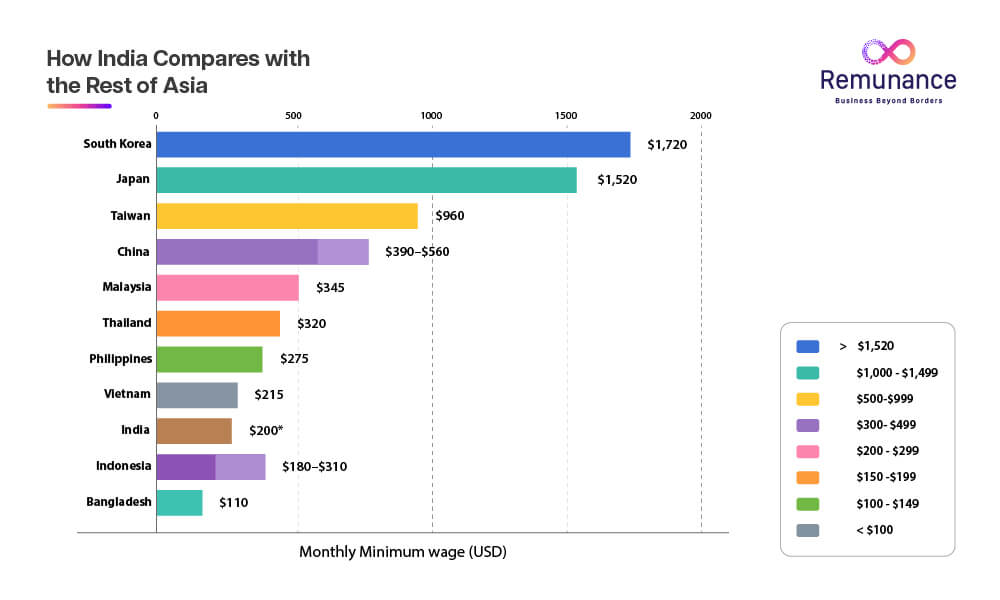
Monthly minimum wage comparison across Asian countries in USD
Two cautions before you read too much into this. Minimum wage is not a market salary.
A senior Indian engineer regularly earns more than a senior Vietnamese one, even though India sits below Vietnam on the floor.
And the total cost of employment (the figure your finance team actually cares about) includes PF, gratuity, ESI, professional tax, and statutory bonus, which together add roughly 18 to 22% to gross pay in India.
Minimum Wage vs Living Wage
This is the tension that drives most labor debate in India. Minimum wage is the statutory floor.
A living wage is what someone genuinely needs to live on. Housing, food, healthcare, transport, education for one child, and basic discretionary spend. Without going into debt.
The Global Living Wage Coalition’s 2024 study for Delhi NCR pegged the living wage at ₹22,696/month, or roughly $239.
That figure has crept up with inflation; an inflation-adjusted 2026 number for Delhi NCR sits closer to ₹26,000 ($274). In Mumbai and Bengaluru, the gap is wider due to housing.
Stack that against Delhi’s minimum unskilled wage of ₹18,456 ($195), and the problem is obvious.
The statutory floor covers about 75% of a basic dignified existence in the National Capital Region. In smaller states, it’s worse. Rajasthan’s unskilled rate of ₹7,410/month is somewhere between 30% and 40% of the local living wage benchmark.
The Five Compliance Mistakes Foreign Employers Make Most Often
Mistake 1: Treating India as one country for payroll
It isn’t. A flat ₹12,000/month rate that flies in Punjab is a clear violation in Delhi. Multi-state employers really do need a state-by-state revision calendar. Most states revise twice a year, but never on the same dates.
Mistake 2: Confusing CTC with wages
Under the Code on Wages, “wages” has a tight definition: basic + dearness allowance + retaining allowance.
Allowances like HRA, conveyance, and special pay don’t count for minimum wage compliance, even if your offer letter shows a CTC of ₹25,000.
If basic + DA dips below the statutory minimum, you’re in violation.
Mistake 3: Missing the VDA bump
Most states change VDA in April and October by adjusting the existing notification rather than issuing a fresh one.
If your payroll team only watches for new notifications, you’ll miss the half-yearly increases. Set calendar alerts for late March and late September.
Mistake 4: Misclassifying contractors
If a worker reports daily, uses your equipment, follows your hours, and has no other clients, an Indian labor inspector will reclassify them as an employee, no matter what your contract says.
We’ve gone deep on this in our piece on independent contractors in India, and it ties straight back to minimum wage exposure: contractors aren’t covered by it, employees are.
Mistake 5: Forgetting overtime
Anything past 8 hours/day or 48 hours/week is overtime, payable at twice the basic rate. Overtime of more than 50 hours per quarter is illegal in most states.
Foreign employers used to salaried, exempt employees often only discover this during a labor inspection.
Why Most Foreign Employers Use an EOR For Indian Wage Compliance
If you’re hiring one or two people in India, you can probably manage. If you’re scaling past five, the compliance machinery becomes a part-time job in itself. And a part-time job that, done badly, costs you ten times what it saves.
An Employer of Record (EOR) handles all of this for you. They’re the legal employer in India; they cut the payroll, file the returns, track the state revisions, and absorb the regulatory liability.
You keep operational control over the actual work. We’ve broken down the EOR vs PEO trade-off in our guide to international PEO services if you’re trying to figure out which model fits.
Pricing for India-focused EORs typically starts at around $99 per employee per month for India-only specialists and runs $400 to $600 for global EORs covering 100-plus countries.
The right pick depends on whether you’re hiring exclusively in India or building a multi-country team.
Our comparison of the top international PEO companies in India walks through the trade-offs, and the EOR cost calculator gives you a quick number for your specific team size.
Whichever route you go, the test for a good EOR is whether they can answer a few questions on the spot: which state notification governs your worker, what the current Basic + VDA breakdown looks like, and when the next revision is due.
Anyone who can’t will cost you money eventually. Remunance has been doing this for 21+ years and serves clients across 21 countries, which is why the compliance machinery sits at the heart of the service rather than as an afterthought.
Remunance Employer of Record
Hire in India in 48 hours, fully compliant
Remunance is one of India's most established EOR providers, with 21+ years of experience and clients across 21 countries. We handle wage compliance, payroll, statutory filings, and benefits across all 28 states.
Talk to an Expert What is The Latest Central Government Hike In Minimum Wages For Unorganized Workers?
The most recent central revision came on April 1, 2026. The Ministry of Labor & Employment, through the Chief Labor Commissioner’s office, raised the Variable Dearness Allowance for centrally-governed unorganized sector workers by 11.28 CPI points.
In rupee terms, that worked out to a ₹37/day bump across all four skill grades.
The hike covers workers in the central sphere. Construction labor on CPWD projects. Sweepers and watch-and-ward staff at central PSUs.
Mine workers in coal and metalliferous operations. Loaders and unloaders at major ports.
Agricultural labor engaged on central schemes. Private security guards are covered under central notifications.
Here’s where the new floors landed for unskilled workers across the three area classifications:
| Area | Pre-revision (Oct 2025) | Post-revision (Apr 2026) | Monthly (×26) |
| Area A (metros) | ₹790/day | ₹827/day | ₹21,502 |
| Area B (tier-2 towns) | ₹659/day | ₹693/day | ₹18,018 |
| Area C (rural & smaller) | ₹520/day | ₹556/day | ₹14,456 |
The semi-skilled, skilled, and highly skilled grades received proportionate increases. The next central revision is due on October 1, 2026, and the August CPI-IW print will roughly indicate where it lands.
One thing worth flagging. The central hike doesn’t automatically push state-notified rates upward.
Most states publish their own VDA tables based on state-level CPI numbers, which can run higher or lower than the central figure.
The April 2026 central bump matters mostly to employers with workers under central jurisdiction.
For a foreign business with a white-collar team in Bengaluru, Pune, or Gurgaon, the rate that binds you is the state notification of Karnataka, Maharashtra, or Haryana, not the central one.
Why Does India Not Have A Single National Minimum Wage?
Two reasons, one constitutional, one historical.
The constitutional one. Labor sits in the Concurrent List of the Indian Constitution, which means both the Center and the states are entitled to legislate on it.
When the original Minimum Wages Act came in back in 1948, the architects deliberately split jurisdiction. Industries with national reach (railways, ports, mines, central PSUs) went to the Center.
Everything else stayed with the states. The thinking was simple. A textile worker in Surat lives a very different life from a textile worker in Coimbatore, so a single nationwide rate would either set the floor too low for one or price the other out.
The historical one is messier. India’s economy is deeply uneven. The cost of living in Mumbai sits at roughly 2.5x that of Patna.
Productivity in Karnataka’s IT corridor is incomparable with farm labor in eastern Uttar Pradesh.
A national wage pegged to the highest-cost zone would gut employment in the lower-cost ones. Pegged to the lowest, it would barely matter in the metros. So India ended up with a layered system that lets each state calibrate to its own economic reality.
The Code on Wages, 2019, doesn’t fully resolve this, but it does try to put a floor under the floor.
Section 9 of the Code empowers the Center to fix a binding National Floor Level Minimum Wage below which no state is allowed to drop.
Once that figure is gazetted (the current ₹178/day is still advisory, not binding), it’ll serve as a true national baseline. States will keep their own higher rates. No state will be allowed to undercut the floor.
There’s also a political angle worth being honest about. Wage notifications are politically sensitive.
Each state government wants to claim credit for raising wages and avoid blame for any job losses that follow.
A single national rate would strip away that local control. Whatever the constitutional theory says, that’s a hard sell in any coalition government in Delhi.
For a foreign employer, the practical takeaway doesn’t change. You’re never bound by one rate.
You’re bound by the rate that applies to a specific worker, in a specific state, in a specific scheduled employment, on the date the salary credit clears. Which is why a wage compliance map is genuinely useful, not a luxury.
Where Can You Find Official Minimum Wage Updates And Notifications?
A handful of sources, in rough order of authority and usefulness.
The Ministry of Labor & Employment
website: https://www.labour.gov.in/
The Center’s hub for the Code on Wages, the consolidated rules, and central sphere notifications. Useful for the legal text itself. Slow at publishing individual state revisions.
The Chief Labor Commissioner (Central)
website: clc.gov.in/clc/min-wages
The CLC’s office publishes central sphere VDA notifications twice a year, in April and October. This is the source you actually want for centrally-governed industries. Notifications usually go up within a week of the effective date.
State Labour Department websites
Every state runs its own. Examples:
Coverage and update frequency vary wildly. Karnataka and Maharashtra are reliable. Some smaller states still publish PDFs as scanned image files that aren’t machine-readable.
State Government Gazettes
The legal source of truth. Every wage revision must be gazette-notified before it takes legal effect. Most states maintain a digital gazette portal, though search functionality ranges from decent (Maharashtra) to genuinely painful (Bihar).
The Labour Bureau
website: labourbureau.gov.in
Publishes the Consumer Price Index for Industrial Workers (CPI-IW) that VDA revisions are pegged to.
The monthly index print is what triggers the half-yearly recalculations. If you want to anticipate a VDA change before the official notification drops, watch the August and February CPI-IW prints.
The Press Information Bureau
website: pib.gov.in
Most central government revisions get a press release here on the day of notification. Easier to skim than the gazette, though not the legal source.
Trade newsletters and consultancies
Firms like Nishith Desai, Cyril Amarchand, AZB, and TeamLease push out wage update circulars in March-April and September-October. Most are free if you sign up. They aren’t authoritative, but they’re a useful early heads-up.
For a foreign employer running payroll across multiple states, the honest answer is that no single source covers everything.
The cleanest setup is to track the CLC for central rates, subscribe to the state Labour Department mailing lists where they exist, and have someone watch the gazettes for the states you actually employ in.
Or hand the whole thing to an EOR who is responsible for never missing a notification.
How Can Remunance Help?
Wage compliance isn’t a problem you solve once and forget. It’s a recurring obligation that drifts every six months as VDAs reset and states publish fresh notifications.
Remunance has been running this kind of compliance machinery for 21+ years across all 28 Indian states and 8 union territories.
What that looks like in practice:
Fully compliant payroll, in INR, on the last working day of the current month.
We’re the legal Employer of Record in India. We cut the salary, deduct PF, ESI, professional tax, and TDS at source, file the monthly and annual returns, and absorb the regulatory liability.
Your employee gets a fully compliant Indian payslip. You get a single consolidated invoice in your home currency.
State-by-state wage tracking.
We maintain an internal calendar that flags every state revision before it takes effect.
April and October VDA bumps. January and July for Maharashtra. March for Uttar Pradesh. Ad-hoc state notifications when they drop. If your worker’s minimum wage changes, the salary structure is updated before the gap becomes a violation.
Code on Wages restructuring.
We’ve spent the last year helping clients re-draw salary structures to meet the new 50% basic-pay rule without inflating their total payroll cost.
If your existing CTC structure front-loads allowances (a very common Indian pattern), we’ll show you how to bring it into compliance without surprises.
Faster setup than a subsidiary.
A registered Indian subsidiary takes 3 to 4 months to set up and runs ₹15-20 lakh a year just to maintain. We onboard a new hire in 48 hours under our existing legal entity. No Indian company registration, no annual filings, no ongoing exposure on your books.
Coverage for full-time, part-time, and fixed-term roles.
All three are covered by the Code on Wages. We handle gratuity accruals for fixed-term workers (the new one-year threshold), full-and-final settlements within 48 hours, and statutory bonus calculations.
We currently work with clients across 21 countries, most of them US, UK, Australian, Singaporean, and European businesses hiring teams in India for the first time. A typical engagement covers between 1 and 50 Indian employees, though we also run larger payrolls.
If you’d like to map your specific situation against current state notifications and get an honest read on your exposure, book a free expert call, and we’ll walk through it with you.
Remunance Employer of Record
Stay Compliant with India’s Minimum Wage Laws
Manage payroll, VDA revisions, PF, ESI, gratuity, and Code on Wages compliance across all 28 Indian states with Remunance’s EOR experts.
Book a Free Expert Call FAQs
What is the minimum wage in India in 2026?
There’s no single answer. India’s minimum wage in 2026 varies by state, skill level, industry, and zone. The advisory National Floor Level is ₹178/day (~$1.88). Central sphere rates run from ₹827 to ₹1,094/day. State-notified monthly minimums range from ₹7,410 in Rajasthan to ₹22,411 in Delhi, depending on skill category.
What is the minimum hourly wage in India?
India doesn’t notify wages by the hour. Hourly is derived from the daily wage divided by an 8-hour standard day. Take the central skilled rate of ₹1,008/day, divide by 8, and you land at ₹126/hour, or about $1.33.
What is India's minimum wage in USD?
At the late-April 2026 USD/INR rate of roughly ₹94.85, the National Floor of ₹178/day is $1.88. Central sphere rates run from $8.72 to $11.53 per day. Monthly state minimums for skilled workers go from $103 (Rajasthan) to $236 (Delhi).
How is minimum wage calculated in India?
Minimum wage = Basic Wage + Variable Dearness Allowance (CPI-linked, revised twice a year) + applicable HRA. Under the Code on Wages 2019, Basic + DA must be at least 50% of total CTC. Calculations use a 26-day working month.
Does the minimum wage in India apply to remote workers employed by foreign companies?
Yes. Indian labour law applies to where the employee physically works, not where the employer is incorporated. A US company hiring a developer in Pune is bound by Maharashtra’s minimum wage and Code on Wages obligations. The cleanest way to stay compliant is through an Indian Employer of Record.
How often does India revise its minimum wages?
Most states revise the VDA component twice a year (April and October). Maharashtra revises in January and July. Uttar Pradesh revises annually in March. The basic wage (the underlying structure) gets reviewed every 3 to 5 years under the Code on Wages.
What happens if I underpay the minimum wage?
Under the Code on Wages, a first offence carries a fine of up to ₹50,000. Repeat offences within five years can mean up to ₹1,00,000 in fines plus up to three months’ imprisonment. The affected worker can also claim up to ten times the underpaid amount as compensation, on top of the back wages.
Is there a minimum wage for IT and software workers in India?
Yes, ever since the Code on Wages took effect on April 1, 2026. IT and ITES employees fall under the Shops & Commercial Establishments scheduled employment in most states. The legal minimum is well below typical IT market salaries (₹60,000 to ₹85,000/month for mid-level engineers in Bengaluru), so it rarely binds in practice. It still matters for compliance documentation.
What's the difference between minimum wage and living wage in India?
Minimum wage is the legal floor set by government. Living wage is what someone really needs to cover housing, food, healthcare and basic discretionary spend without going into debt. The Global Living Wage Coalition’s 2024 Delhi NCR figure of ₹22,696 ($239) sits roughly 23% above Delhi’s unskilled minimum wage. In smaller states, the gap is wider.
Can I pay an Indian employee in USD instead of INR?
Not if they work and live in India. Indian residents have to be paid in INR through an Indian bank account, with statutory deductions (PF, ESI, TDS, professional tax) applied at source. Companies sometimes structure stock or bonus components in USD, but base salary has to be Indian. An EOR handles the conversion automatically.
Why is the minimum wage in India so low compared with other Asian countries?
A few structural reasons. India runs a huge informal labour market (about 80% of total employment) and an oversupply of low-skilled workers. There’s also an explicit policy stance of keeping the country competitive for labour-heavy manufacturing. The Code on Wages and the slow push toward a binding national floor are gradual attempts to close the gap.

Related Posts

Average Salary in India (2026) Across Cities and Industries

A Comprehensive Salary Calculator India and Payroll Optimization

How to Pay Employees in India

Salary Structure in India: Key Things to Know


