IT Services Industry Challenges 2026: Business Growth Solutions
The blog covers major IT services industry challenges in 2026. These include talent shortages, cybersecurity threats, and fast tech changes. It also offers ways to train workers, boost security, and use flexible business models to stay ahead.
📑 Table of Contents
The IT industry does not enter 2026 cautiously. It enters under pressure. It enters under pressure to scale faster. Pressure to secure more. Pressure rises to follow more rules, manage tighter budgets, and still provide great customer experiences.
What used to be considered “IT problems” is now a business risk.
In 2026, IT teams are no longer evaluated solely by uptime. They are measured by how well they help growth, build trust, and adapt to change smoothly.
This shift changes everything. It affects how teams are built, how systems are designed, and how decisions are made.
To understand IT challenges and solutions for 2026, we must look at where old models fail. Then, we can find what will replace them.
When Technology Becomes the Business Backbone
In earlier years, IT supported business strategy. In 2026, IT is a business strategy.
Customer experience depends on system performance. Revenue depends on integrations. Compliance depends on data architecture. Expansion depends on infrastructure readiness. A single weak link can stall growth across the organization.
In 2026, the IT industry faces new challenges. These are not just technical issues. Instead, they involve organizational and operational strain.
The Shift From IT Execution to IT Ownership
In 2026, IT teams are no longer judged by how well they execute instructions. They are judged by how well they make decisions.
Distributed systems, global customers, and asynchronous work have made constant centralized control impossible. Waiting for approvals slows business. Escalations break momentum. Over-documentation replaces accountability.
The most effective IT organizations now operate on ownership models. Teams understand business context, not just tickets. Engineers are expected to evaluate trade-offs, manage risk, and act without constant oversight.
This shift separates scalable IT organizations from fragile ones.
Ownership does not mean lack of governance. It means clear responsibilities and authority linked to accountability. Trust is built through systems, not just supervision.
As organizations scale globally, only ownership-based IT models can handle complexity without bottlenecks.
Core Challenges Facing the IT Industry in 2026

1. Customer Expectations Outpace System Readiness
Customers in 2026 expect speed, consistency, and reliability across every digital touchpoint. They do not separate product, service, and technology. To them, it is one experience.
A slow dashboard feels like poor service. A failed integration feels like incompetence. Downtime feels like betrayal.
The challenge for IT teams is not building features. It is maintaining experience quality at scale.
What must change
IT teams must align system metrics with business outcomes. Monitor indicators that impact customers. Key areas include response time, transaction success, and data accuracy. Experience reliability must become a design principle, not a post-launch fix.
2. Cybersecurity Evolves From Risk to Reality
Cybersecurity threats in 2026 are persistent, adaptive, and increasingly automated. AI-driven attacks target vulnerabilities faster than traditional defenses can respond. Threat actors aim at more than just software problems. They also exploit human actions, vendor dependencies, and flaws in processes.
The cost of a breach is no longer limited to remediation. It includes regulatory penalties, customer attrition, brand damage, and leadership credibility.
What must change
Security cannot remain a siloed IT function. It must become a shared responsibility across leadership, operations, and technology teams. Continuous monitoring, zero-trust architectures, role-based access, and real-time incident response are no longer optional.
Cybersecurity Is Now a Business Continuity Function
By 2026, cybersecurity failures no longer sit in isolation. They cascade.
A breach disrupts operations. Operations delays impact customers. Customer trust affects revenue. Revenue loss triggers leadership scrutiny.
This chain reaction has turned cybersecurity into a business continuity function.
IT leaders need to plan for prevention, containment, recovery, and communication too. Incident response playbooks, escalation protocols, and cross-functional drills are as important as firewalls.
Security maturity in 2026 is measured by how fast an organization can stabilize, not just how well it can defend.
When Security Complexity Becomes the Real Threat
By 2026, many organizations will use dozens of overlapping security tools. Each tool adds data, alerts, and dashboards. Instead of clarity, teams get noise.
This complexity slows decision-making and hides genuine threats behind false positives.
The smarter approach
Security stacks must be simplified and integrated. Fewer tools with clearer ownership outperform fragmented systems. Security should reduce uncertainty, not add to it.
3. Talent Shortage Turns Into a Talent Structure Problem
The IT talent gap continues in 2026, but the challenge has evolved. Skilled professionals exist. What’s missing is alignment between talent expectations and organizational design.
Rigid job roles, limited autonomy, and outdated career paths push top talent away. Meanwhile, companies struggle to scale teams fast enough to meet demand.
What must change
Hiring models must shift from role-based to capability-based. Teams should be assembled around outcomes, not titles. Continuous upskilling, internal mobility, and flexible work models are now strategic necessities.
Burnout, Attrition, and the Cost of Invisible Work
One of the least discussed IT challenges in 2026 is invisible work.
Context switching. Manual handovers. Repeated clarifications. Poor documentation. These drain productivity without appearing on dashboards.
Over time, this leads to burnout, attrition, and declining delivery quality.
High-performing IT organizations actively design systems to reduce cognitive load. Clear roles, shared tools, and open communication help protect people and their work. Steady workflows also play a key role in ensuring safety.
Talent retention in 2026 is as much about system design as it is about compensation.
Talent Gaps Are Symptoms, Not the Disease
The real issue in 2026 is not talent availability. It is outdated operating models.
High-performing IT teams thrive on ownership, flexibility, and clear impact. Organizations that shift how they organize work can better hire, attract, and hold on to top talent.
4. Compliance Complexity Expands Across Borders
By 2026, regulatory requirements will affect nearly every IT decision. Data privacy laws, labor regulations, industry standards, and cross-border compliance rules create a dense web of obligations.
Manual compliance tracking increases risk. One misstep can lead to fines, audits, or reputational damage.
What must change
Compliance must be built into systems from the start. Automated reporting helps cut down risks. Access controls keep data secure. Data localization frameworks ensure compliance. Audit-ready documentation makes operations smoother. Compliance should enable scale, not restrict it.
Compliance Without Automation Does Not Scale
Compliance complexity in 2026 is not just about more rules. It is about simultaneous jurisdictions.
An IT system might need to follow data protection laws, employment rules, industry standards, and contracts all at once.
Manual compliance tracking increases operational risk and slows decision-making.
The solution is automation-first compliance. Access logs, audit trails, payroll docs, and data residency controls should be part of the systems from the beginning. They shouldn’t be added later.
Organizations that automate compliance early gain speed, confidence, and audit readiness.
5. Budget Constraints Clash With Rising Expectations
Despite increasing demands, IT budgets remain under scrutiny. Leadership expects innovation, security, and scalability without proportional cost increases.
In most cases, the issue is not insufficient budgets. It is inefficient spending.
Cloud Is Not Expensive, Lack of Governance Is
Cloud infrastructure enables scale, but uncontrolled usage leads to unpredictable costs. Idle resources, duplicated services, and inefficient architectures inflate expenses silently.
By 2026, cloud cost governance becomes a leadership priority, not an operational afterthought.
What must change
IT teams need to focus on:
- Cost visibility
- Automated alerts
- Usage accountability
- Regular optimization reviews
This helps in managing resources effectively.
Cloud spend should be predictable, measurable, and tied directly to business value.
Remunance Employer of Record
Overcome Your IT Challenges with the Right Partner
Don’t let cybersecurity threats, skill shortages, or budget limits slow your business growth. With the right strategies and expert guidance, you can turn these challenges into opportunities for innovation and success.
Talk to Our IT Experts
Structural Solutions Shaping the IT Industry in 2026
Distributed Teams Become the Default, Not the Exception
Remote IT teams are no longer experiments. They are the operating model of choice.
Organizations that manage global teams can tap into larger talent pools. They also cut costs and grow more quickly. The key lies in governance, communication, and compliance alignment.
Legacy Systems Quietly Block Growth
Many IT organizations enter 2026 carrying legacy architecture that was never designed for scale.
Tightly coupled systems resist change. Custom integrations increase fragility. Outdated infrastructure consumes resources without delivering flexibility.
The challenge is not replacing everything. It is knowing what to modernize, what to isolate, and what to retire.
Strategic modernization focuses on reducing dependency risk first, not chasing new tools.
Automation and AI Move From Efficiency to Stability
In 2026, automation is not about speed alone. It is about resilience.
Automated monitoring and AI-driven incident detection cut down on manual work. Predictive maintenance and workflow automation also help reduce reliance on people. This allows teams to focus on strategic initiatives instead of firefighting.
Governance Without Bottlenecks
Strong IT organizations balance flexibility with control. Clear ownership, standard processes, and open decision-making keep chaos at bay. They also help teams stay quick and efficient.
Governance in 2026 is not about approvals. It is about clarity.
What IT Leaders Must Do Heading Into 2026
Shift From Reaction to Ownership
The most successful IT leaders in 2026 do not chase issues as they arise. They design systems that absorb change without breaking.
They simplify before scaling. They invest in people alongside tools. They align IT decisions with business outcomes.
Most importantly, they treat IT not as a cost center, but as a growth engine.
When Global IT Scale Meets Operational Reality
Building strong IT operations in 2026 often requires going global. This can happen even before internal systems are fully prepared.
Hiring across borders introduces new complexity. Compliance, payroll, local labor laws, and operational alignment can slow down IT teams as they grow.
This is where structured global employment models matter.
Remunance helps global companies build IT teams in India. We manage employment, payroll, compliance, and local operations. This lets leadership focus on technology results instead of administrative risks.
The goal is not outsourcing. It is operational clarity while scaling responsibly.
For IT leaders, this means fewer compliance issues. They can onboard teams quickly. This helps keep operations smooth in a complex global environment.
Scale Your IT Operations with Global Remote Teams
Expand your business reach and access top IT talent worldwide. Build high-performing remote teams that help you save costs, improve productivity, and stay competitive in the global tech market.
Advantages of EOR Services for Building Remote Teams in India
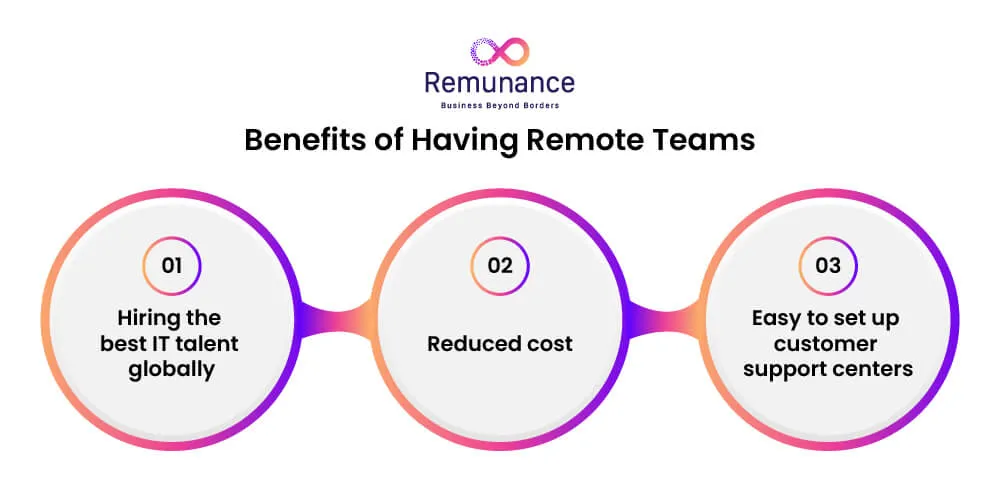
When we say remote team building, some services like ‘outsourcing’, ‘contracting’, and ‘subsidiary formation’ may come to your mind.
Over the last two decades, IT outsourcing has been a popular option for many tech companies aiming to operate key business functions remotely.
Also, India remains one of the most attractive destinations for IT outsourcing services.
On the other hand, an employer of record (EOR) is another business model that provides the most cost-effective service for team building in India.
Unlike IT outsourcing services, EORs help you build a remote team in India with better control and management of your employees.
Let’s explore the advantages of having remote teams in India.
Two major advantages of building remote teams in India for IT companies are as follows:
-
- You can easily access and hire tech-savvy Indian talent as the country has a vast talent pool.
- Hiring tech talent in India can be cost-saving, as you can hire them at a reduced cost compared to many Western countries.
However, one major challenge you’re more likely to face when expanding a team in India is navigating regulatory compliance.
This means you must comply with the existing laws and regulations governing the hiring and employment of remote professionals in India.
India has a complex set of employment laws and regulations, and handling such legal procedures can be daunting if you’re entering the Indian market for the first time. Even for many old players, navigating Indian employment laws can be tough.
Then, you may ask, “How do I go about it?” The answer is simple: you can use EOR to build and operate an Indian team with zero legal complications.
Let’s understand the major benefits of using EOR services when IT companies expand a team in India.
-
- Regulatory compliance assurance: EORs ensure that your business operates in the Indian market in compliance with the existing Indian labor laws and employment regulations.
An EOR handles compliance matters related to payroll, tax withholdings, and other legal responsibilities that a foreign company must meet when operating in India. In other words, EORs shield you against compliance risks.
- Regulatory compliance assurance: EORs ensure that your business operates in the Indian market in compliance with the existing Indian labor laws and employment regulations.
-
- Talent acquisition: Your EOR partner helps you find the best talent from a large pool of skilled IT professionals in India.
EORs have well-established networks and extensive local knowledge that can assist businesses in recruitment.
They scout, screen, and shortlist the Indian candidates who can rightly fit your requirements.
- Talent acquisition: Your EOR partner helps you find the best talent from a large pool of skilled IT professionals in India.
-
- Cost-effective operations: Partnering with an EOR lets you take advantage of cost-saving measures, as you do not need to form a legal entity in India.
Your EOR partner will serve as a local guardian for your Indian team, handling all legal requirements for your employees.
This means partnering with an EOR enables you to save on upfront investment costs required in setting up a legal entity. - HR service supports: EORs provide a range of human resource (HR) service supports, leading to better management of your remote workforce.
In addition to onboarding and offboarding, an EOR handles employee benefits like medical and insurance benefits, leave/attendance, and retirement plans for your remote employees.
Simply put, better employee management means reducing turnover risks and enhancing productivity.
- Cost-effective operations: Partnering with an EOR lets you take advantage of cost-saving measures, as you do not need to form a legal entity in India.
To sum up, you can use EOR services for various supports and advantages, such as compliance assistance, talent acquisition, cost-saving, and HR functions to manage your Indian team better.
By transferring all administrative responsibilities for Indian employees to your EOR partner, you can focus entirely on core activities such as business innovation and growth.
Check out how IT companies expand teams in India using EOR services.
Conclusion
With the rising demand for automation and the embrace of digitization in the corporate world, the importance of the IT industry has become more evident.
Businesses across various sectors often integrate advanced technologies to stay ahead of the competition and enhance productivity.
However, tech companies still face challenges, such as a shortage of IT talent, compliance regulations, and budget constraints, which are roadblocks to their business growth.
Building a remote team outside your country is a solution to address the IT Services industry challenges.
It’s due to several benefits, such as easy access to global talent, lower employee-hiring costs, and cost-saving business operations.
India has emerged as a major destination for building remote teams due to abundant IT talent and cost efficiency.
Also, using EOR services will make your team-building and business operations in India easy, as your EOR partner will handle tasks, such as compliance assurance, talent acquisition, and HR functions of your employees on your behalf.
About Remunance
Remunance is an Employer of Record (EOR) services provider in India, helping global companies hire, manage, and support full-time employees without setting up a local entity. We take care of HR, payroll, compliance, and benefits so businesses can focus on growth while building their teams in India with confidence.
Remunance enables businesses from UK, Australia, Canada, France, US, and the Middle East to recruit, hire, and manage workforce and benefits in India.




Related Posts

7 Benefits of an Employer of Record Services

How to Choose the Best Employer of Record?