


Solving US Labor Shortages With Employer of Record Services
The US labor shortage is slowing hiring, delaying projects, and increasing operational pressure for businesses. This article explains how Employer of Record (EOR) services help companies access global talent, hire faster, stay compliant, and build stable teams in markets like India without setting up a local entity.
📑 Table of Contents
The US labor shortage doesn’t arrive as a headline moment. It arrives as friction. Hiring plans look fine on paper. Headcount approvals exist. Budgets are allocated. Yet roles stay open longer than expected. Teams stretch. Managers redistribute work. Deadlines quietly move.
At first, this feels manageable. Then it compounds. Projects don’t collapse. They slow. And slowdown is harder to diagnose than failure.
Across industries such as technology, healthcare, banking and financial services, logistics, and professional services, the pattern is similar.
The problem is no longer finding better candidates. It’s finding enough of them, fast enough, without breaking the business in the process.
Employer of Record services shift from being an HR topic to an operational choice.
The US Labor Shortage is Structural, Not Cyclical
Many organizations assumed hiring would normalize after the pandemic shock. It hasn’t.
The U.S. workforce is constrained by long-term forces that aren’t easily reversible. A large portion of experienced workers are aging out.
Participation rates in certain job categories continue to lag. The demand for skilled, compliance-aware, and reliable talent has grown.
What’s changed is not ambition. Its availability. Businesses still need to execute. Regulatory requirements haven’t softened. Customer expectations haven’t lowered. Technology stacks haven’t simplified. But the pool of readily available domestic talent has tightened.
This creates a mismatch that recruitment tactics alone can’t fix.
Facing hiring delays right now?
See how companies are hiring globally without adding legal risk.
Why Traditional Hiring Starts to Break Under Pressure
U.S. companies often hit limits when trying to solve labor shortages with familiar methods.
Domestic hiring becomes a race where speed and cost move in opposite directions. Faster hiring often means higher compensation, sign-on incentives, and compromised fit. Slower hiring protects quality but delays delivery.
Immigration-based hiring introduces a different constraint. Even when suitable candidates exist, timelines rarely align with business urgency.
Visa approvals, regulatory uncertainty, and compliance risks create problems. Most operational teams can’t consistently manage these issues.
Setting up foreign entities looks good on paper, but in practice, it’s a different story.
Legal structuring, tax registrations, and payroll systems add to fixed costs. Local compliance and ongoing administration also contribute.
For many companies, that investment makes sense only after they reach scale. It doesn’t make sense when hiring pressure is already high.
Each option solves part of the problem. None solves it fully or quickly.
Where Employer of Record Changes the Equation
Employer of Record services help companies hire across borders. They do this without the burdens of local employment laws.
An EOR becomes the legal employer in the hiring country. The client company controls the work. It decides roles and responsibilities. It sets performance expectations and outcomes.
This separation matters.
It helps businesses expand their hiring reach while lowering legal risks. In practice, this reduces time-to-hire, compliance exposure, and internal administrative load.
For organizations facing labor shortages, speed isn’t just a convenience. It’s continuity.
Global Hiring Alone isn’t the Solution. Structure is.
Many companies attempt international hiring informally before considering EOR. That’s where issues surface.
Employment laws differ widely. Payroll rules are unforgiving. Misclassification risks carry real penalties. Termination processes vary more than most leadership teams expect.
These aren’t theoretical risks. They surface during audits, funding rounds, acquisitions, and regulatory reviews.
Employer of Record services absorb this operational complexity. They localize compliance while allowing the business to operate as one organization.
That structure is what makes global hiring usable at scale, not just possible.
Why India Continues to Be a Practical Answer
India frequently enters these conversations for reasons beyond cost.
There is depth in many areas. These are technology, analytics, finance, healthcare, customer support, and compliance. More importantly, there is continuity. Teams don’t just fill gaps; they stay, grow, and compound knowledge.
Many professionals already operate within U.S. business contexts. Communication styles, documentation standards, and reporting expectations are familiar. The learning curve is shorter than expected.
When companies hire through an Employer of Record in India, they skip setting up an entity. This way, they stay compliant with local labor laws. This allows for a response to US labor shortages. It avoids committing to permanent structures too soon.
For many organizations, India is not just an offshore option. It’s a smart choice for workforce design.
Remunance Employer of Record
Considering India for global hiring?
See how companies hire compliant, full-time teams without entity setup.
Hire in India via EOR
India-Specific Hiring Cost Comparisons: US vs India Through an EOR
When U.S. companies explore global hiring, cost isn’t always the main focus. More often, they worry about unfilled positions, delayed projects, and stretched teams.
The difference between U.S. and India hiring is not about discount labor. It is about how labor markets are structured.
Here are typical yearly cost ranges for common roles. These figures are based on market benchmarks and include EOR employment costs. These figures reflect total employer cost, not just base salary.
| Role | United States (Annual Employer Cost) | India via EOR (Annual Employer Cost) |
| Mid-Level Software Engineer | USD 120,000 – 160,000 | USD 30,000 – 45,000 |
| Senior Software Engineer | USD 160,000 – 200,000+ | USD 45,000 – 65,000 |
| Finance Operations / Accounting | USD 80,000 – 110,000 | USD 22,000 – 35,000 |
| Data Analyst / Reporting Role | USD 90,000 – 130,000 | USD 28,000 – 45,000 |
| Customer Support / Back Office | USD 55,000 – 75,000 | USD 15,000 – 25,000 |
These are not entry-level comparisons. They reflect skilled, experienced professionals operating in structured business environments.
The key difference is not just the headline number. It is volatility.
U.S. salary bands move quickly due to competition, counteroffers, and retention pressure. Indian salary bands change slowly. This helps companies manage workforce costs and avoid surprises during the year.
Cost is Not Just Salary; It’s Time, Stability, and Predictability
When roles stay unfilled for months, the financial effects go beyond payroll. There’s lost productivity, missed revenue, and burnout among existing teams.
EOR-led hiring shifts the focus from what does this role costs to what does the delay costs.
Direct Compensation
In many skilled jobs, pay in India is often lower than in the U.S. This difference is due to labor market factors. It also relates to living costs and available resources.
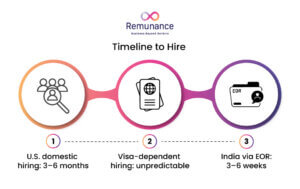
Hire faster during the U.S. labor shortage with Employer of Record hiring in India.
For example:
Mid-Level Software Engineer
In the U.S., competition drives up salaries, and retention costs are high. Salary bands change quickly, creating replacement risks.
In India, through an EOR, compensation is based on skill and experience. It’s not about cheap labor; it’s about predictable costs for planning.
Finance Operations and Accounting Roles
In the U.S., talent is scarce, and turnover is high, especially in compliance roles. Payroll costs rise faster than productivity.
India has a lot of skilled workers. They know global accounting standards. They also have experience with audits. With an EOR, companies can access this talent without long commitments.
Customer Support and Back-Office Functions
U.S. hiring faces challenges like gaps in coverage and high attrition.
India has scalable teams. It offers reliable coverage in different time zones. Attrition is lower in organized settings. Here, reliability adds value alongside cost.
Overall, the benefit isn’t just lower wages; it’s cost stability.
U.S. labor markets see sharp salary shifts, while Indian markets adjust gradually. This helps businesses forecast workforce costs clearly.
Employment Overheads
In the U.S., the real cost of employment goes well beyond base salary.
Employers must consider payroll taxes, healthcare, insurance, compliance, and ongoing HR costs. These can change unexpectedly.
When hiring through an EOR in India, these costs still apply but are managed effectively.
Companies can skip building their own compliance systems. Instead, they pay a single monthly fee. This fee covers payroll, tax compliance, required benefits, and labor law adherence. This simplifies HR challenges into manageable costs.
The Hidden Cost That Often Matters Most: Delay
One of the highest overlooked costs of U.S. labor shortages is opportunity loss.
Every month, a role stays unfilled:
-
- Projects slow down.
- Delivery timelines extend.
- Revenue opportunities fade.
- Existing teams take on extra work.
These costs often don’t appear in hiring spreadsheets but impact operations significantly.
Hiring through an EOR cuts time-to-hire dramatically. Often, roles are filled in weeks, not months.
EOR hiring can save money. It’s often cheaper than waiting for local talent. This is true even before considering salary differences.
EOR vs Outsourcing
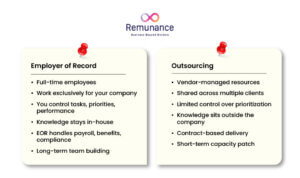
EOR builds dedicated teams, while outsourcing relies on shared vendor resources.
Employer of Record services are often misunderstood as a form of outsourcing. That misunderstanding leads to poor decisions.
Outsourcing transfers work to an external vendor. Control, prioritization, and knowledge sit outside the organization.
EOR extends the internal team. Employees focus on the company, follow its processes, and learn over time.
When the goal is to solve labor shortages sustainably, this distinction matters. Outsourcing patches capacity. EOR builds capability.
Control, Risk, and Operational Confidence
A common concern among leadership teams is loss of control. In practice, EOR arrangements often increase clarity rather than reduce authority.
Operational control remains with the company. The EOR handles employment-related tasks, including payroll, benefits, tax compliance, and labor law compliance.
This division allows leadership teams to focus on output rather than employment mechanics. It also reduces exposure during audits, restructuring, or expansion events.
The risk doesn’t disappear. It becomes manageable.
Why This Model Works Under Labor Constraint
Employer of Record services excel because they address multiple challenges at once:
-
- Speed without sacrificing quality
- Compliance without extra internal costs
- Flexibility without long-term risks
For U.S. companies dealing with labor shortages, this model changes how they hire.
Organizations can build a workforce that crosses borders. They don’t have to wait for domestic markets to improve.
This change goes from reactive hiring to planned workforce design. It shows the true value of EOR services.
Remunance Employer of Record
Labor shortages aren’t going away.
Design a workforce that doesn’t depend on one geography.
Talk to an EOR Specialist From Hiring Problem to Workforce Strategy
US labor shortages are forcing a broader rethink.
The question is no longer whether talent exists. It’s whether existing hiring models are flexible enough to access it responsibly.
Employer of Record services help companies decouple growth from geography. That flexibility is becoming a structural advantage rather than a temporary workaround.
For organizations willing to adapt, EOR isn’t about filling roles faster. It’s about designing a workforce that can withstand constraints.
FAQs
Is employee misclassification illegal?
It lets companies hire worldwide without needing to set up entities. This cuts down the time to hire and eases compliance.
Can U.S. companies legally hire employees in India without a local entity?
Yes. An Employer of Record manages legal employment while the company directs the work.
Is EOR suitable for long-term teams or only short-term hiring?
EOR supports both. Many companies use it to build long-term, stable teams.
What roles are commonly hired through EOR?
Technology, analytics, finance operations, healthcare administration, customer support, and compliance roles are common.

Related Posts

How New H-1B Visa Rules Impact Hiring Strategies

A Basic Guide to US Work Visa Sponsorship

