What Are the PEO Pros and Cons You Must Be Aware of in 2026?
A Professional Employer Organization (PEO) can help companies focus on their core business by performing their HR tasks. But you must understand a PEO pros and cons before outsourcing your HR tasks to it. A PEO can help you save employee costs, but it can also make you lose some control.
📑 Table of Contents
Many businesses get so bogged down by administrative tasks that they cannot manage their employees efficiently.
But if employees don’t perform their best, a business will never succeed. This is where a Professional Employer Organization (PEO) steps in.
A PEO can perform all human resources (HR) and administrative tasks, like managing employee payroll, complying with labor laws, etc.
But before hiring a PEO, as a business owner, you must understand the pros and cons of using a PEO’s services.
Otherwise, you may make a mistake, which can have far-reaching consequences on your business.
What is a PEO, And How Does It Work?
A professional employer organization (PEO) is a service provider that helps your business get the best out of its employees. You may wonder how.
A PEO and a business follow a co-employment model. As a result, they share responsibilities regarding employees.
A PEO takes care of employee payroll, employee benefits, HR administration, and legal compliance.
Meanwhile, a business sets goals for its employees, manages their performance, and makes all the decisions regarding hiring/firing its workforce.
Now, let’s discuss the pros and cons of a professional employer organization (PEO).
Unlock Smarter HR with a PEO Today
Simplify HR, payroll, and compliance while you focus on growing your business.
PEO Pros and Cons You Must Know
While PEOs have pros, they have cons as well. So, let’s discuss this aspect in detail.
What are the Benefits of Using a PEO?
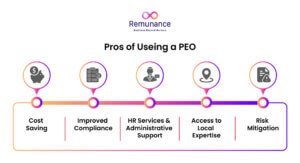
op benefits of a PEO for business growth and compliance
Cost Saving
Imagine a small business negotiating a health insurance policy for its employees with a large insurance company.
Because it has a small workforce, the insurer may ask it to pay an extremely high premium per employee.
However, a PEO can negotiate a lower premium because it has a large client base, so it negotiates for a large pool of employees.
Similarly, PEOs can negotiate better rates for all kinds of employee benefits. Let’s say your company decides to offer gym membership to its employees.
If you approach a PEO with a wide employee base, it can get you a low per-employee rate from a gym.
PEOs Can Help Improve Legal Compliance:
Many countries have extremely complex employment-related laws.
For example, in India, companies must comply with numerous central and state-level acts.
While large companies can hire legal experts to comply with all regulations, many medium and small businesses find it daunting to navigate all the laws.
Hence, PEOs can enable such enterprises to comply with all applicable laws so they don’t incur penalties.
In India, a PEO can draft employment contracts, make tax deductions at source (TDS), contribute towards EPF (Employees’ Provident Fund), and register with ESI (Employees’ State Insurance Corporation), thereby reducing an employer’s overload.
End-to-end HR Services and Administrative Support
Just think of what a company has to do to hire a few employees. Even before they join, it has to check their background, prepare offer letters, and collect all the documents.
Once employees join, it has to process their payroll, manage their leaves, track their attendance, enroll them for health insurance, and administer their retirement plans.
PEOs can manage a company’s HR functions by performing all the above-mentioned tasks. As a result, your company can focus on just managing employees’ performance.
Provide Local Expertise
Companies find it tough to hire talent in a foreign country because they lack local expertise. Let’s say that an American company wants to hire a few employees in India.
It may not be aware of the benefits employees typically expect in India. Moreover, it may not be in a position to negotiate for those benefits.
Besides, it may not know much about the Indian culture at the workplace. By providing local expertise about India, a PEO can make it much easier for a foreign company to hire employees in India.
PEOs Can Help Mitigate Risks and Avoid Legal Penalties
No business can survive without mitigating risks. This is where a PEO can be immensely beneficial.
By helping a business comply with all HR-related laws and regulations, a PEO can ensure it never faces lawsuits or penalties.
Besides, PEOs can advise businesses on how to handle critical situations, such as employee terminations and workplace harassment lawsuits.
By mitigating risks and avoiding legal penalties, PEOs can also help firms maintain a good reputation.
And, a good reputation can help a business attract the best talent and manage relationships with all stakeholders.
Having discussed the pros of partnering with a PEO, now let’s discuss the cons.
What are the Disadvantages of Using a PEO?
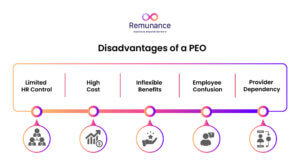
Key drawbacks of using a PEO for your business
A Business May Lose Control
While PEOs have their pros, one of their major cons is that they may cause you to lose some control over your business. Losing such control can result in complex situations.
Let’s say that your employee is not happy with a compensation claim. In the absence of a PEO, your business will handle this issue internally. But if it gets a PEO on board, then the PEO will handle this issue.
The PEO may or may not have the same values or culture as your company. In that case, the situation can become tricky.
Besides, a communication gap can occur between a PEO and your company when dealing with employees’ issues.
A Business May Have To Share Liability Risks With A PEO
As already mentioned, a firm and a PEO follow a co-employment model. It’s true that a PEO handles compliance on behalf of its client.
But a business may still be held responsible if its PEO fails to adhere to all laws and regulations. In other words, a business shares liability risks with a PEO.
A Business Has to Set Up a Local Entity Before Signing Up A PEO
A foreign company cannot hire the services of a PEO without setting up a local entity first.
This can be a big problem if a company wants to scale quickly in a foreign market. Setting up a local entity can be time-consuming and cumbersome.
First of all, a company has to decide whether to set up a local entity. For that, it must do a cost-benefit analysis of setting up a local office.
Then, it must follow all necessary regulations to set up that entity.
Depending upon the location, it can take anywhere from a few days to a few months to do so.
PEOs May Offer Limited Flexibility
Your business may love to offer the compensation package that your employees desire. But when you go through a PEO, it may not always be possible to do so.
What if a PEO offers a pre-set package to your employees? All employees may not be happy with it.
Let’s say that a PEO switches to a different group insurance provider next year. What options will you have? Will you opt for another PEO?
Besides, there can be occasional issues with a service provider, which a PEO may not be able to handle.
Even if you go to a reputable PEO, it may not always get you the vendor that you like. And, once you sign up for a PEO, you may have limited flexibility in such matters. Make sure that you consider this while analyzing the pros and cons of a PEO.
A PEO’s Mistake Can Badly Affect Your Business’s Reputation
If your business has to bear the brunt of a PEO’s mistake, it may damage its reputation, particularly in the case of a lawsuit or a penalty. So, you should be aware of this aspect when examining a PEO’s pros and cons.
You may be unable to attract talented employees once your reputation is damaged. Besides, certain stakeholders may be reluctant to associate with your business in the event of a lawsuit.
Often, the pros and cons of PEOs depend upon the nature and the scale of a business. Hence, you need to know when your business needs a PEO.
When Do the Pros of a PEO Outweigh the Cons?
A PEO’s pros can outweigh its cons only when you carefully analyse whether your business needs it in the first place.
Signs that show that a PEO’s pros can outnumber its cons for your business
-
- If you are spending a lot of time on repetitive HR tasks and are unable to strategize, then you may go for a PEO because it can allow you to concentrate your energy on your business. In this case, a PEO’s pros can exceed its cons.
- At times, businesses get so occupied with day-to-day repetitive administrative tasks that their clients start complaining about incorrect invoices. If you’re facing the same struggle, then a PEO’s pros can exceed its cons because you can outsource your HR tasks to it.
- Some companies may lack a certain kind of HR expertise. Let’s say that you don’t know how to benchmark your employee benefits with those of your competitors. In such a case, if a PEO can analyse employee benefits across your competitors, then the PEO’s pros can outweigh its cons.
- Another situation wherein a PEO’s pros may outnumber its cons is if you don’t know all the laws and regulations that your business needs to follow. In such a case, you may face a lawsuit. Hence, it makes sense to hire a PEO with legal expertise so that you don’t ever face compliance issues.
- Some business owners get so busy signing administrative forms that they lose track of their employees’ performance. If you, too, are facing the same problem, you can hire a PEO. By performing all your administrative tasks, you can rest assured that a PEO’s pros can exceed its cons.
Does your business size and location determine whether a PEO’s pros outweigh its cons?
The size and location of your business can help you figure out whether a PEO’s pros will outweigh its cons. So, let’s discuss size first.
If you’re running a small business or a startup with 5 to 20 employees, it’s possible that you don’t have the resources to have a full-fledged HR team.
And yet, you need to process payroll, maintain HR records, and follow all regulations.
So, you can hire a PEO that can reduce your administrative overload so that you can focus on your business.
But when your business’s size increases, and you have more than 20-30 employees, then the decision to have a PEO becomes more nuanced.
If you have sufficient funds to manage HR in-house, you may not get a PEO on board.
But if you lack a certain kind of expertise, then it may make sense to hire a PEO. Let’s say that you want to provide health insurance to your employees, but you are unable to negotiate the best premium.
In that case, you can hire a PEO who can get you the best insurer for your requirements.
For companies with hundreds of employees, the cons of PEO may outweigh its pros because such large organizations have in-house HR, payroll, and legal teams.
Hiring a PEO can make their organizations extremely complex and also limit their flexibility in making policy decisions. In such cases, a PEO’s pros may not exceed its cons.
Now, let’s say that your business wants to expand into a foreign market and hire talent. You can go through a PEO, but it will require you to set up a local entity first.
Hence, you need to do a cost-benefit analysis of setting up a legal entity in a foreign country to make this decision.
Perhaps, it will make sense for you to go through an employer of record (EOR), which doesn’t require you to set up a local office.
EOR vs PEO: How the Pros and Cons Compare
In this section, let’s compare a PEO vs. EOR. While a PEO and an EOR both can help reduce your business’s HR load, they are fundamentally different.
When a business hires employees through an EOR, those employees are legally the employees of that EOR. But with a PEO, a business follows a co-employment model.
When you expand internationally, if you go through an EOR, you don’t need to set up a local office in a foreign country. So, EORs are popular for firms willing to expand into a foreign country.
On the other hand, you need to set up a local office if you want to hire a PEO.
Now, let’s compare the pros and cons of PEOs with those of EORs.
-
- The pros and cons of PEOs and EORs depend upon your business’s needs. If you want a third-party to become the primary legal employer of your workforce, then EOR is the right choice. But if you prefer a co-employment model, then PEO is the way to go.
- An EOR hires employees on your behalf through its office in a country. As EORs are experts in local laws, they help reduce the possibility of a lawsuit, which is a benefit. But when violations occur, your business can still face consequences depending on the case, which is a disadvantage.
- A PEO follows a co-employment model. It manages your HR operations in a country where your business has a local office. If a legal issue occurs, the responsibility is shared, but your business remains largely responsible in the case of a PEO. So, while assessing a PEO’s pros and cons, you should consider this factor.
- If you want to test a foreign market quickly, you should go to an EOR because it can help you employ people without setting up a local office. But since an EOR acts as a legal employer, your business has less control over employment contracts and employee benefits.
- Meanwhile, if you want to quickly enter a foreign market, a PEO’s pros may not exceed its cons. In fact, a PEO is not the right model in this situation because it requires you to have a local legal setup in the foreign market that you wish to enter.
Are You Struggling With Your HR & Administrative Overload In India? Remunance Can Help You
Remunance has earned an enviable reputation by providing PEO services to many companies over the years.
So, if your company is struggling to manage payroll, benefits, and legal compliance, Remunance can provide comprehensive HR and administrative support so you can focus on your core business.
But why should you select Remunance when there are multiple other PEOs in India? Here’s why:
-
- Remunance provides you with end-to-end HR support by taking care of your compliance, payroll, employee benefits, employment contracts, etc.
- Remunance ensures that your business follows all the local laws mandatory.
- It provides cost-effective solutions for a wide variety of clients.
- It ensures transparency in pricing.
Remunance Employer of Record
Simplify HR in India with Remunance
Design one hiring process and adapt each stage to local markets, laws, and talent needs.
Get Started with Remunance
FAQs
What is a co-employment model in the case of a PEO?
Co-employment means that a business shares its employees’ responsibilities with a PEO. While a PEO handles HR matters like payroll and benefits, a business manages the day-to-day work of its employees.
How can a PEO help a business save employee costs?
PEOs tend to work with many businesses at any given point in time. So, they deal with a wide employee base, which allows them to negotiate a lower rate for many services than a business can negotiate on its own.
Does a business’s size help it determine whether it needs a PEO?
The size of a business does play a role in making this decision. If a business is too small, it may not have the resources to have a full-fledged in-house HR team. In that case, it can hire a PEO, which can perform its day-to-day HR tasks.
Is it necessary to have a local setup when a company decides to hire a PEO?
Yes, it is essential to have a local legal setup before hiring a PEO. However, when a company goes through an employer of record in a foreign country, it is not necessary to have a local office.
Can your business face a legal penalty when it hires a PEO?
Yes, it can happen. When you hire a PEO to manage your HR, you share the responsibility with the PEO. That said, your business still remains legally responsible for any violation.
Does a PEO’s pros always outweigh its cons?
A PEO’s pros cannot always outweigh its cons. It varies from situation to situation. For example, if a large company with an in-house HR team hires a PEO, it can result in a complex situation. But if a small startup hires a PEO, it can outsource all its HR tasks, which can enable it to concentrate on its business.
Which is the better option to enter a foreign market quickly – PEO or EOR?
An EOR does not require a business to have a local office. Hence, if you want to enter a foreign market quickly, you can select an EOR that can hire employees on your behalf. Compared to that, a PEO requires you to have a local office. So, it is more time-consuming.
What are the disadvantages of using a PEO?
PEOs deal with many companies at any given time. They may not change a service provider just to cater to a certain company’s requirements. So, when you approach a PEO, it may offer you a pre-set package for your employees, which you may or may not like.
If you select a PEO, will it be the primary employer of your employees?
No, when you select a PEO, your company is the primary employer of your employees. But the PEO is a co-employer who handles HR and administration-related tasks, like payroll, benefits, compliance, etc.

Related Posts

What Are the Benefits of PEO for Startups?

What Is a PEO and How Can It Help Your Business Grow?

What is an International PEO? Guide for Global Businesses

A Complete Guideline to Choose the Best Indian PEO