A Complete Guide to Doing Business in India
Doing business in India offers global companies access to a fast-growing market, skilled talent, cost-efficient operations, and strong digital infrastructure. This guide covers key benefits, challenges, policy reforms, and smart ways to enter India successfully with local support.
📑 Table of Contents
Setting up a business in another country can be super exciting. Building a new team. Expanding your market reach.
Yet, you might feel slightly challenged too.
India amplifies that feeling, but in a good way.
Doing business in India is nothing but a rewarding experience for many global founders. What attracts India most is a unique set of opportunities that not many countries offer.
India has a huge consumer base, a pool of young and skilled professionals to employ, a robust economy, an improving digital infrastructure, and pro-business policies. Also, India offers a low operational cost.
Whether you’re a small business owner testing the Indian market or a global company planning your next big move, this guide is your starting point.
The guide will help you learn about doing business in India.
-
- Why Choose India for Doing Business?
- Key Benefits of Doing Business in India
- Challenges of Doing Business in India
- How to Address the Challenges for Business Success?
- Let’s Build Your Business in India Together
Let’s dive in.
Why Choose India for Doing Business?
Let’s start with the obvious question. Why choose India as a favorable destination for doing business?
-
- An Ever-Growing Market: A market that never sleeps, always expanding.
- A Steady, Robust Economy: India’s economic growth is impressive, supported by a stable economy with a robust political system.
- Pro-Business Government Policies: Numerous governments’ initiatives and policies to encourage foreign investment and business set up in India. It helps ease of doing business in India.
- Business Policy Reforms: The government’s policy reforms, such as Goods and Services Tax (GST), reduce compliance costs and facilitate easy business expansion.
- Strategic Location: India’s geopolitical influence and maritime importance are keys to global reach for trade opportunities and business setup.
- A global center for innovation: A leading hub for innovation, market leadership, and a research center for global business operations.
- Digital infrastructure supports: Harnessing India’s digital power and world-class infrastructure supports.
1. An Ever-Growing Market
Waiting to gain traction before opening an office is not an innovative way to enter the Indian market. It’s a market that is always expanding in terms of investment flow, customer base, etc.
You don’t need to wait for the right time to invest.
It’s a market with a potential 1.4 billion consumers, promising GDP growth, and thriving industries.
Most importantly, the large size of the Indian middle class and its growing demand for premium goods are key factors fueling the market.
2. A Steady, Robust Economy
As one of the fastest-growing economies, India shows its promising economic stability to the world. It’s a country where street vendors accept digital payments.
India’s GDP growth is impressive. Soon, the country is likely to be the world’s third-largest economy with an expected GDP of $7.3 trillion by 2030.
Such impressive growth is the result of the widespread adoption of digital technology and a supportive ecosystem for entrepreneurs and investors.
3. Pro-Business Government Initiatives
Startup India, Make in India, and Digital India are notable government initiatives that aim to foster a supportive ecosystem for domestic and international investment.
India’s startup ecosystem ranks among the world’s strongest, with over 159,000 DPIIT-recognized startups. This is a result of India becoming a more business-friendly destination.
Also, initiatives such as liberalized foreign direct investment, special economic zones (SEZs), and corporate tax incentives provide global enterprises with flexible entry options into India.
4. Business Policy Reforms
The government has implemented several policy reforms over the years to make entry rules in India easier. India’s policy has now become more business-friendly.
For example, the recent Goods and Services Tax (GST) simplifies the tax and compliance burden for global investors. Now, the approval process is much easier with a single-window system.
The country’s top regulators, including the Reserve Bank of India (RBI) and the Securities and Exchange Board of India (SEBI), simplified compliance regulations.
And the results are clear. India witnessed as many as 185,000 new companies registered in 2023–24, its highest ever.
5. Strategic Location
India’s geographical location is a crucial factor for attracting global leaders. It sits in a strategic location for international trade, connecting the East and West.
Its maritime importance through the Indian Ocean connects a broader trade route.
Also, the country is a gateway to various regions. In the north, it connects the Middle East to Europe or Africa, and in the east, it connects Southeast Asia to East Asian countries.
This offers immense business opportunities.
6. A Global Center for Innovation
Many global leaders consider India the preferred destination for innovation and business strategies.
India is the global hub for establishing global capability centers (GCCs).
These centers are key to generating strategic business value, including innovation, research & development (R&D), and product testing & development.
7. Digital Infrastructure Supports
India has a strong digital infrastructure, facilitating the seamless functioning of the digital economy. It’s the backbone that strengthens the country’s economy.
As per a government report, the digital economy’s share in India’s GDP contribution would be one-fifth by 2030. In 2022-23, the contribution was about $402 billion, representing 11.74% of the country’s GDP.
India is investing more. It’s not just digital investment.
India has been heavily investing in developing smart cities, IT parks, and more. These are strong infrastructure supports required to meet the growing demands for a global market destination.
Build Your Global Capability Center in India
Global Capability Centers (GCCs) help enterprises drive innovation, optimize costs, and scale faster. Discover why India is the preferred destination for setting up GCCs and how global companies gain a strategic edge with the right local support.
Key Benefits of Doing Business in India
Let’s explore three major, unique benefits of doing business in India.
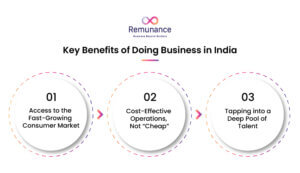
Key benefits of doing business in India including market access, cost efficiency, and talent pool
1. Access to the Fast-Growing Consumer Market
One of the biggest advantages of doing business in India is the access to a fast-growing consumer market.
The country has a large chunk of young and middle-aged population. This is a key reason for fueling the demand for high-end products, durables, and gadgets.
India is on track to hit a $7 trillion GDP, driven by the growing size of consumer spending and demographics.
2. Cost-Effective Operations, Not “Cheap”
Many international businesses choose India to optimize costs.
In India, you get modern facilities and high-end infrastructure at lower costs. But that doesn’t mean lower quality.
As compared to many Western countries, India’s labor fees and land leasing costs are considerably affordable for global businesses.
This is one crucial reason for doing business in India as a smart long-term strategy.
3. Tapping into a Deep Pool of Talent
India is a major hub for producing a vast number of skilled engineers, designers, analysts, and business professionals every year.
If finding the right talent is your priority, doing business in India gives you more than enough to build strong teams.
As mentioned by Livemint, India gained its share of AI and STEM professionals’ contributions globally by 1.9% and 1.4% points, respectively. Now, the country is one of the top 10 talent hubs globally.
Challenges of Doing Business in India
Learn those key challenges you may encounter when doing business in India. Here they are:
-
- Regulatory Complexity: Handling India’s employment rules and regulations can be tough due to its complexity.
- Bureaucratic Burden: Lengthy bureaucratic processes and red tape issues could be a burden.
- Infrastructure Challenges: Infrastructure in non-tier 1 cities is not as robust as in Tier-1 cities.
- Compliance & Taxation Risks: Even minor errors in compliance and tax regulations can lead to undesirable consequences.
- HR Complexity: Managing the Indian workforce requires a thorough understanding of the complex work culture and ethics.
- Intense Competition: Competition is generally high in the Indian market due to the presence of strong players.
Regulatory Complexity
India has a complex set of regulations for global enterprises to follow. You must comply with the regulations related to Indian company setup, licenses, labor laws, and regular filings.
You might need approvals from both central and state authorities when setting up a business in India.
Bureaucratic Burden
The country has significantly improved the overall bureaucratic and administrative processes associated with setting up business in India.
Yet, you often need to follow up on banking, paperwork, and government clearances.
Infrastructure Challenges
Not all Indian cities have the same facilities and infrastructure.
Choose the Tier-1 cities if you need strong internet connectivity, power support, or logistics assistance for your office or team.
But, you may experience standard service quality and infrastructure facilities as you move from Tier-1 to Tier-2 or -3 cities.
Compliance & Taxation Risks
India’s compliance system is clear but strict. Ensure you comply with GST filings, payroll system, taxation, etc., to avoid penalties.
Due to high risks, many companies outsource compliance responsibilities to a local third-party expert. This ensures minimizing risk and staying focused on growth.
HR Complexity
Each country has a different system or policies related to human resources (HR) or workforce management.
India is no exception. From hiring to payroll to working hours, India has a complex set of rules and regulations.
On top of the local labor and employment laws, you also must learn more about the Indian work ethic and company culture.
Intense Competition
Entering India is, of course, rewarding. Yet, you must prepare and face the intense competition from local and already-established competitors.
There’s an ideal way to stay competitive in the Indian market. Learn the people’s sentiment and know the local market nuances.
How to Address the Challenges for Business Success?
Let’s understand the ways to address the challenges.
-
- Socio-cultural Diversity: India is known for its socio-cultural diversity. It’s many markets within one.
- Relationship Building: Not just deals, you need to build a strong relationship with your Indian partners.
- Need Patience: Stay patient and don’t rush the process as the administrative processes don’t complete overnight.
- Local assistance: With a local service provider like an EOR partner, your journey to set up business in India will be easy.
Socio-cultural Diversity
There’s a saying here: “Each Indian state is like a country of its own.”
Kashmir to Kanyakumari (North to South) and Mumbai to Manipur (West to East), each state has unique characteristics, such as language, socio-culture, and customer behavior.
Understand the local market nuances and set your market approach accordingly. That’s how brands build trust here.
Relationship Building
In India, trust comes before transactions. Business meetings might take longer, and follow-ups might feel endless.
But relationship building is part of doing business in India. Try to find any common ground between you and your partner company.
People here want to know who they’re doing business with, not just what you sell.
Need Patience
Need a little patience when dealing with the administrative or bureaucratic processes.
Paperwork or approval may take time. Don’t rush it.
When we help clients set up businesses in India, the ones who stay patient end up building stronger foundations.
Local Help
Instead of trying to figure out every rule and obstacle yourself, we advise you to work with a local partner like us.
If you’re testing the Indian market, you definitely need our assistance. We help ease your administrative burden by providing hand-holding guidance.
On your behalf, we handle registration, compliance service, legal documentation, taxation, recruitment, and payroll. While we handle your administrative burden, you can focus on optimizing your business strategy and growth.
Your journey to setting up a business in India could never be easier. With our employer of record (EOR) service, you choose the smartest way to enter the Indian market.
Remunance Employer of Record
Crack the Code to Doing Business in India
Enter India’s market smoothly with the right local support. Let us handle compliance, HR, and payroll, so you focus on growth.
Start Your India Expansion Today
Let’s Build Your Business in India Together
If you think of handling the complex regulations of India all by yourself can feel like solving a maze.
That’s where EOR, a local business support service, comes in and can make a world of difference for you.
Let’s take the burden off your shoulders. Allow us to help you with an end-to-end solution from recruitment to compliance assistance.
This is the way we help our clients to build a business in India.
Conclusion
Successful global business leaders know the unique opportunities of doing business in India. They know how to tap into these opportunities before they actually start setting foot in India.
The smartest option to start a business in India is partnering with a local service support.
When working with an EOR partner like Remunance, you can skip the part on how to set up a business in India. You can directly plan for long-term business growth and success.
Start Smart in India with the Right Local Partner
Skip entity setup and enter India faster with Remunance as your Employer of Record. Focus on growth while we handle compliance and operations.

FAQS
Is India a favorable country to start a business for global leaders?
Yes. India is one of the most rewarding countries for business expansion. Global leaders choose the country due to its benefits, such as talent opportunities, cost-saving operations, and a large customer base.
What is the easiest way to start a business in India for a foreign company?
Taking local help, such as an employer of record (EOR), can be the easiest and safest way to start a business in India. Let them handle the administrative, non-core business activities, from talent acquisition to compliance on your behalf.
Which is the best business structure for foreign investors in India?
Many foreign companies choose a private limited company. You can opt for other business structures, such as a wholly owned subsidiary.
How much time does it take to register a company in India?
Normally, 2 to 4 weeks to register a company in India. In some cases, such as lacking proper documents, it may take a little longer.
Related Posts

Advantages and Disadvantages of Doing Business in India

The Ultimate Guide to Business Expansion in India