Borderless Hiring: How it is Impacting the Corporate World
Borderless hiring has emerged as an important trend that has changed how companies employ people. Digital collaboration tools have altered how people used to collaborate at work. Hence, employees do not have to work from the same physical office, as they can work-from-anywhere.
📑 Table of Contents
Until a few years ago, before COVID-19 struck, terms like “borderless hiring” or “remote work” were not popular.
If a company had to recruit people, working from the office was the norm. When businesses had to find talent, their search was mostly limited to their home country.
But then the pandemic happened. People were forced to work from home. Technologies like Google Meet, Zoom, and Trello revolutionized the very idea of working.
People could work from anywhere and collaborate digitally with their colleagues spread worldwide. And, companies started hiring people across geographies and time zones.
In other words, borderless hiring emerged as one of the most profound trends of the 21st century.
Read this blog, as it explains what borderless hiring is, its advantages, and challenges.
What is Borderless Hiring, and How Has It Emerged as a Significant Trend?
Borderless hiring has emerged as an important trend that is shaping industries worldwide, but what does it mean?
Let’s discuss it further.
What is the Meaning of Borderless Hiring?
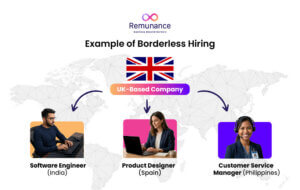
Example of borderless hiring with global remote team expansion
When a business hires employees from anywhere in the world instead of limiting its search to its own country, it is called borderless hiring.
Such hiring does not require the selected employees to relocate to the country or city where the physical office is. So, employees, thus selected, work remotely, mostly from their homes.
Besides, such employees work in different time zones. But they are able to seamlessly work together thanks to the emergence of several digital tools.
How Has Borderless Hiring Emerged As A Significant Trend?
The following points explain why borderless hiring is emerging as a major trend in the corporate world:
1. COVID-19 Pandemic:
When the pandemic happened, many companies were forced to shut their offices. But they continued to produce output because their employees were asked to work from home.
Before the pandemic, only 15% workers worked from home. But this number increased to around 30% during the pandemic.
Once COVID-19 struck, there was a sudden realization that companies don’t need their workforce to come to the office. So, they started encouraging their employees to work remotely. Moreover, they started finding talent outside of their home countries.
2. Emergence of Digital Tools:
The last few years have seen rapid growth in technology. As a result, companies don’t need physical offices.
Today, tools like Google Meet and Zoom can help you connect with your employees located in any part of the world. You don’t have to worry about how to manage a remote workforce.
With tools like Dropbox and Google Drive, people can share and store documents online. Gone are the days when you had to be in the same office to pass on documents to each other.
Moreover, project management tools like Asana and Trello allow you to track tasks and deadlines remotely. Thanks to these tools, you don’t need a boss sitting in the same physical office as you.
You can delegate tasks and track your employees’ performance from anywhere.
3. Digital Nomad and Remote Work Visa Programs:
Many countries in Asia, Europe, the Americas, and Africa offer digital nomad visas. Such visas give a boost to borderless hiring.
Let’s say there’s a software engineer called Amit. Amit is a permanent resident of India, but he works for a US-based company.
Suppose he gets a digital nomad visa from a European country. This visa will allow Amit to work for his US-based employer from that European country.
Typically, a digital nomad visa allows a person to stay longer in a country than a tourist visa. Hence, it’s specifically designed for remote workers like Amit.
This visa will allow Amit to work from that European country. He’ll also get a chance to explore it in a way a tourist visa may not allow him. So, such visas allow people to have a borderless career.
4. Advanced Human Resources (HR) Technologies:
When companies hire people from a foreign country, they may face some challenges. This is because different countries have different rules for payroll, taxes, visas, etc.
But companies have found a way to address this complexity through advanced HR technologies and global mobility platforms. These technologies allow companies to automate employee onboarding processes, track compliance, and secure data.
As a result, companies can hire global talent from anywhere, which helps them scale easily.
Build a Global Team with Borderless Hiring
Hire top talent worldwide, reduce costs, and scale faster with expert support.
What Are the Advantages of Borderless Recruitment?
Let’s discuss the main benefits of borderless hiring.
Much wider pool of talent
Around a decade ago, if you were to hire a content writer who could write in English, you were most likely to find someone in your own country or city.
But today, with technological growth, you can find such a content writer anywhere in the world. Besides, this change is not just limited to content writers.
Whether you want financial analysts, software engineers, digital marketers, graphic designers, data analysts, or online trainers, you can hire a much wider pool of talent today due to borderless hiring.
Cost-effective
Trends like remote work and borderless jobs help companies save a lot of money. First, they don’t have to set up huge physical offices, as many of their employees work remotely.
Hence, work-from-office is reserved for only a few employees. Besides, they can access talent in countries with much lower salaries than in their own countries.
Several companies in Europe and the US are hiring talented workers in Africa and Asia, where salaries are much lower than in the Western world.
Better workplace cultural diversity
When you hire employees across many cultures, it helps bring new and fresher perspectives. This can enable your organization to become more creative, resilient, and agile.
Moreover, if you have customers in many countries, it will also help your team understand those customers better if they are already interacting with colleagues from that part of the world. So, cultural diversity is one of the major benefits of borderless hiring.
Quicker scaling and hiring
Due to borderless hiring, companies are not limited to their home countries when it comes to selecting the right employees. If they don’t find the right candidate in their countries, they can expand the search to other countries.
They don’t have to wait endlessly to find candidates in their countries.
Besides, if a business wants to expand into a foreign country, it can hire employees from that country by using the services of an Employer of Record. So, businesses can grow and scale quickly.
Having discussed the benefits of borderless hiring, let’s talk about its challenges.
Can Borderless Hiring Be Difficult For A Company?
Borderless hiring can be difficult due to the following challenges:
Compliance-related challenges
When a business hires an employee in a foreign country, it has to follow the laws prevailing in that country. And, rules regarding employment and taxes may vary across countries.
If a business doesn’t have expertise in those laws, it may face problems. So, borderless hiring comes with compliance-related issues.
Misclassification risk
At times, companies misclassify workers as contractors when recruiting across borders. Many countries have implemented strict rules to prevent such misclassification.
If a business makes such a mistake, it can be made to pay hefty penalties. Often, authorities penalize companies with effect from a past date for making such errors. Besides, it can also damage a business’s reputation.
After a loss of goodwill, it can become extremely difficult for a business to attract talent. In the worst case, investors may stop trusting such a corporation.
Managing compensation across geographies can be difficult
When you hire employees across multiple countries, you face the risk of currency fluctuations.
In case your home country’s currency depreciates vis-à-vis the currency of the country in which you have hired employees, your salary expenditure in your local currency will increase.
Besides, people in another culture may have completely different salary expectations. For example, in some countries, salaries tend to increase at a higher average rate than in other countries.
If you employ people in such countries, you need to manage their expectations regarding salary growth.
Besides, employees’ expectations regarding insurance, healthcare, and retirement benefits may vary across countries.
What is acceptable in a European country may or may not be acceptable in an Asian country, which poses a challenge to companies hiring remotely.
Data security could be a challenge
When a company has employees in many countries, it poses risks related to data security. At times, employees in different locations may send sensitive information (regarding their employer or customers), which can end up being tricky.
Hence, businesses must adhere to laws like the General Data Protection Regulation (GDPR).
Communication across different time zones can become tough
It can be very difficult to manage communication across different time zones.
Let’s say you’re running a US-based company with employees in an Asian country that has a 12-hour time zone offset from your time zone.
In such a case, you may find it very tough to schedule meetings that suit everyone. Especially when you’re facing a tight deadline or a critical meeting, different time zones can be tricky.
Which Industries are Leading in Terms of Adopting Borderless Work?
Let’s look at industries that are leading this transition to borderless or remote work. While many sectors are offering remote work, the following industries stand out:
Information Technology (IT)
The IT sector is usually the first to adopt a major digital trend. So, it comes as no surprise that it is one of the major sectors that hires people across borders.
As per a news article, borderless hiring is becoming popular for tech roles.
Besides, for most IT jobs, the only things you need are a laptop and a reliable internet connection. Therefore, such jobs can be done from anywhere.
Major roles for which the sector is recruiting across borders include product developer, cybersecurity expert, software engineer, etc.
Design & Creative
Many companies in design and creative work, like advertising, are using digital tools for cross-border collaboration.
You would often come across a graphic designer working from one country for a design studio or an advertising firm located in another country.
Availability of creative talent worldwide and the adoption of digital tools have made it possible. That said, at times, companies have to embrace a different culture when outsourcing design work to an employee in another country.
For example, a lot of creatives are needed during the time of festivals. In India, prominent festivals include Diwali, Christmas, Eid, etc. Such festivals may vary from culture to culture.
When you hire designers from another culture, you need to train them about the popular festivals in your culture and other norms.
Finance
The financial industry is also aggressively hiring employees across borders. While accounting rules may differ from country to country, the basics of finance remain mostly the same.
Hence, it makes sense for finance companies to find talent outside of their geographical borders.
Moreover, virtual collaboration tools and cloud-based platforms have enabled finance firms to find top-quality talent across borders.
Common finance roles for which companies use borderless hiring are investment analysts, bookkeepers, risk & compliance specialists, treasury professionals, and auditors.
Start-ups
Usually, start-ups want to expand quickly. So, they need to hire the best available talent. Hence, they are often keen to employ people from another country, provided they get the right fit.
Many firms may hire cross-border employees for lower salaries. But start-ups have different reasons to go beyond their geography. They need to survive and then scale up quickly. For that, they need immensely talented people.
They are willing to pay employees who fit their requirements, regardless of their location.
Education
Digital technology has fundamentally changed the education sector. Today, students across age groups enroll in online courses. Often, trainers and students of online courses are from different countries.
Online courses are offered in various formats, such as live and recorded classes, providing many options to choose from. Moreover, such courses are often backed by reputed universities.
Remunance Employer of Record
Tap Into Global Talent Across Leading Industries
From IT to finance, hire top global talent and scale your business faster.
Explore Global Hiring Solutions
How Will Borderless Hiring Evolve in the Future?
Based on all the indicators, it seems that borderless hiring is here to stay. In fact, the trend is going to strengthen in the near future. So, let’s discuss the direction it’s expected to take:
-
- Fully distributed companies: Many companies don’t see borderless hiring or remote hiring as a temporary phenomenon. They think this trend is permanent. Moreover, firms are hiring remote talent for all kinds of roles, right from top management positions to mid-level and entry-level executives. This shows that some companies may have a fully distributed model very soon.
- Government policies and digital nomad visas: Many governments are expected to revise their policies to promote borderless hiring. Hence, more countries are likely to offer digital nomad visas in the future. By offering such visas, these countries will also be able to position themselves as business-friendly.
- Skill-based hiring will get a boost: As more companies hire remotely, the skills of employees will play a greater role in selection than their degrees. Which university or B-school you went to will matter less. Instead, what you can do for a company through your skills will matter much more in the future.
- Tools to automate HR processes will be an enabler: Many tools are already helping companies track employee data and compliance globally. In the near future, more such tools are expected to revolutionize how companies hire remote workers. These tools will help companies automate HR processes and hire people across borders. Moreover, they will not have to worry about complex payroll and legal processes, which are otherwise a huge concern.
How Does An Employer Of Record (EOR) Service Provider Help You In Remote Hiring?
An EOR service provider helps you recruit employees in a foreign country without requiring you to set up an office in that country.
An EOR manages tasks related to employee payroll, benefits, compliance, and employment contracts. Meanwhile, your business manages the day-to-day work of employees.
As a result, your business doesn’t get bogged down with HR and administrative tasks. Moreover, EORs allow you to focus your efforts on your business.
If you want an employer of record (EOR) to help you employ talented people in India, you can contact Remunance.
As an employer of record, Remunance has helped many companies in:
-
- Finding the best talent available in India for remote work.
- Following all the prevailing laws and regulations.
- Signing agreements, onboarding employees, providing HR support, and retaining employees.
Remunance Employer of Record
Hire in India Faster with an EOR
Skip entity setup. Stay compliant while we handle payroll, HR, and onboarding.
Start Hiring with EOR
Conclusion
The trend of borderless hiring is likely to accelerate in the near future for many reasons. First, digital collaboration tools have enabled cross-border teams to collaborate seamlessly.
Second, companies realize that they can grow and scale faster by hiring employees remotely. Besides, remote work helps both companies and employees.
Third, organizations are getting in touch with an employer of record (EOR), which can help them recruit talented employees in a country without opening an office there.
FAQs
How have digital tools helped companies hire international employees?
Digital tools like Trello have helped companies track tasks remotely. Then, tools like Google Drive have enabled people to share documents with their colleagues from anywhere.
Moreover, with Google Meet and Zoom, you can interview and meet people digitally. Simply put, you don’t have to be in the same physical office to work with your colleagues.
How have digital nomad visas given a boost to flexible work?
If you want to explore a foreign country for a longer period than a tourist visa allows, then digital nomad visas could be a great option.
Such visas allow you to work in a foreign country. You are not a permanent resident of such a country, and you very often don’t even work for an employer based in that country. Still, thanks to such visas, you can stay and work from that country.
How can an employer of record (EOR) give a boost to remote work culture?
An EOR can help a company employ people in a foreign country without having a local office there. In this manner, EORs can give a boost to remote-first culture.
When it comes to borderless jobs, which roles are the most popular?
Some of the most common roles for which borderless jobs are famous include digital marketers, graphic designers, financial analysts, software engineers, data analysts, and online trainers.
What are the main challenges when it comes to borderless hiring?
When companies hire remote workers, they face compliance-related challenges. This is because employment-related laws tend to be different in different countries.
Besides, employers may find it tough to meet the expectations of remote employees regarding compensation. Moreover, a fluctuating exchange rate may expose them to currency risk when hiring employees globally. These are the main challenges of borderless hiring.
What is the main reason that start-ups hire remote workers?
Start-ups typically want to find people who fit their requirements totally. For that, they usually don’t care about the geographic location of an individual.
If they really need someone, they can pay a very high salary to get the person on-board. Many start-ups hire all kinds of employees (including senior management roles and entry-level employees) remotely.
Which trends are likely to boost borderless hiring in the near future?
Trends like the growth of digital tools, digital nomad visas, and automation of HR processes are expected to make more companies hire remote employees in the near future.

Related Posts

International Recruitment – How to Adapt Your Hiring Process for Different Countries

The 5 Fastest Growing Remote Hiring Destinations in 2026

A Guide for Hiring International Employees

Best EOR Service Providers in India (2026) for Easy Hiring

Why Global Companies Are Hiring Remote Employees from India